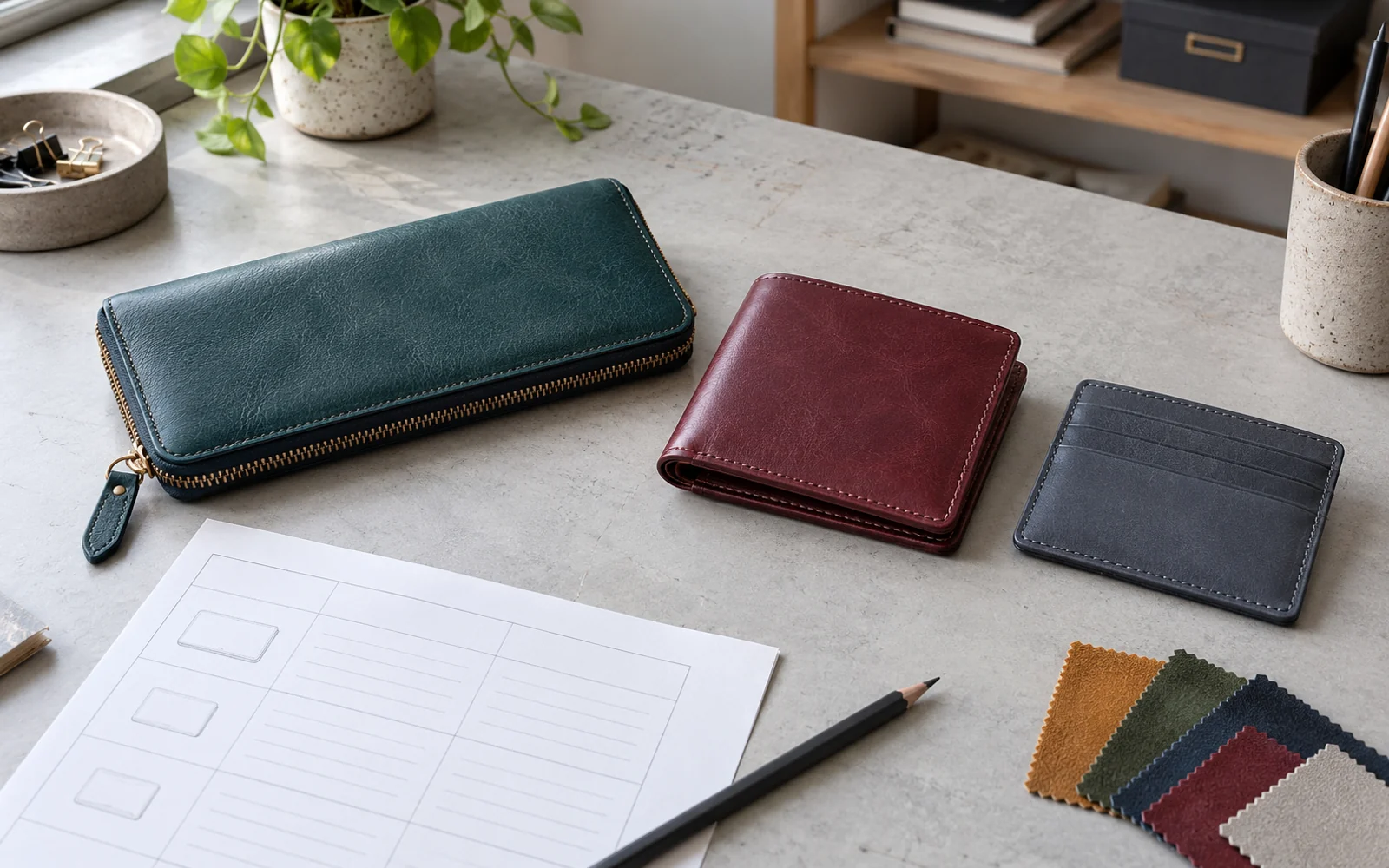
A reference marked "compact wallet" can produce several different quotations. One supplier may allow for a coin pocket, another may omit it, and neither may know whether the buyer expects bills to remain unfolded. The product name starts a conversation; it does not define the item being priced.
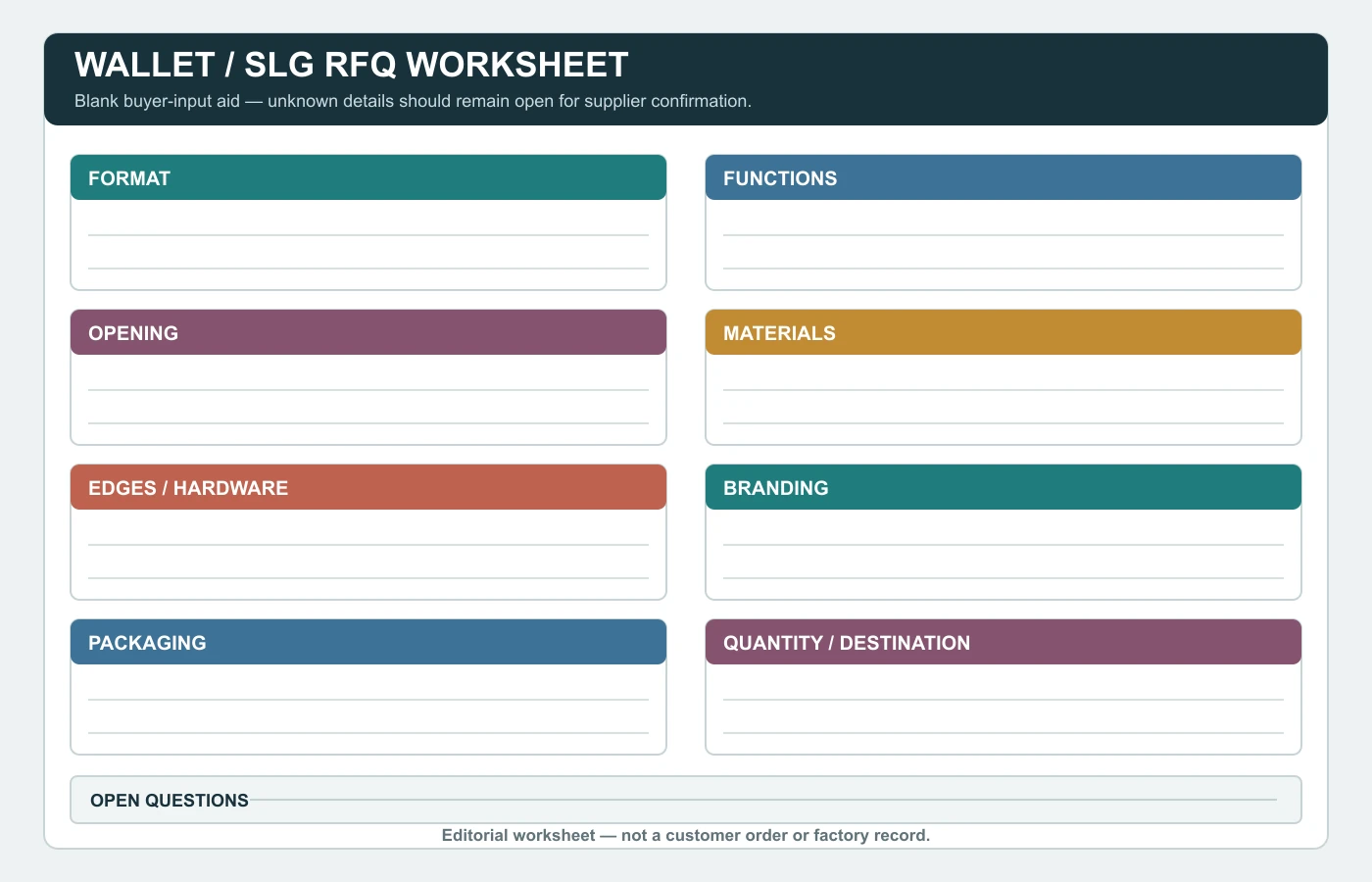
For wallets and small leather goods wholesale projects, make those assumptions visible before comparing offers. Record the format, required functions, opening, material direction, visible edges and brand placement. Keep unknowns as questions instead of filling a drawing with guessed dimensions.
The aim is a reviewable brief for a brand, wholesaler or sourcing team. It is not a requirement to finish a full technical pack before contacting a supplier, nor a promise that every reference can be developed unchanged.
Define the Small Leather Goods Format First
Name the format and explain what it needs to do. A long wallet might be requested around a bill compartment, while a short or folding wallet introduces decisions about the folded state and access. A zip-around version brings a defined opening route into the discussion. A card holder may have no separate closure; a compact pouch needs its own content and access brief.
These are directions to discuss, not fixed constructions. Mark the closed appearance, how the item opens and the categories of belongings it should hold. If the product belongs to an assortment, identify what distinguishes it from the other pieces rather than describing every item as compact storage.
You can browse wallet and small leather goods formats to identify references. Record the specific style that interests you. A collection page is a browsing starting point, not confirmation of current stock, internal layout or available modifications.
Map Card, Bill, Coin and Document Functions
Record Functions Before Drawing Slots
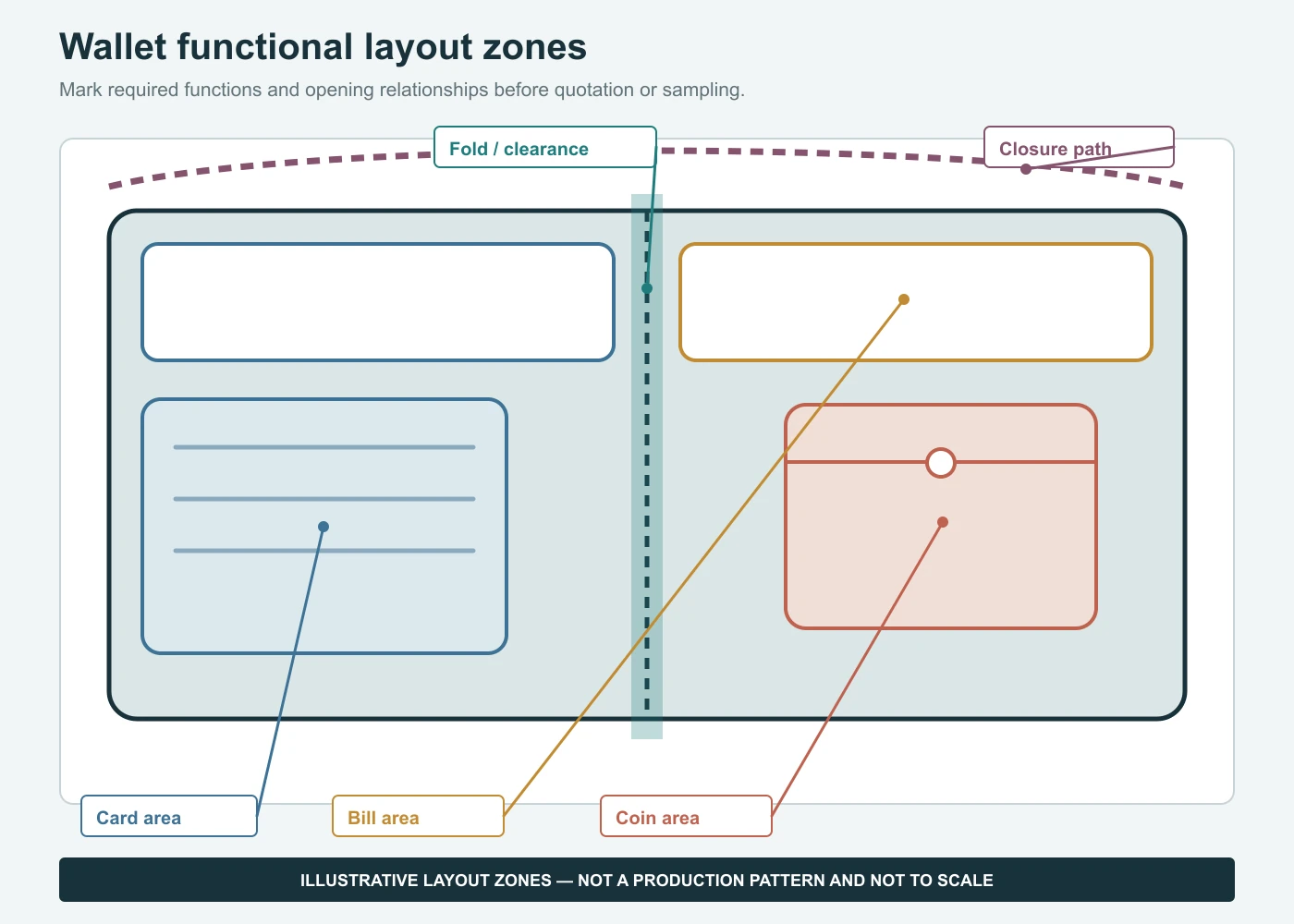
List the required objects first: payment cards, bills, coins, an identification document or receipts, for example. Decide which functions are essential and which are optional. Then mark proposed areas on an open view, identifying their position, opening direction and requested count where known.
When fit for a particular card, document or currency matters, provide the actual target and relevant market requirements. Leave missing dimensions open for confirmation. A label such as "card slot" does not settle the usable opening, insertion direction or fit of every intended object.
Review Access and Overlap
Consider the folded or closed item as well as the flat layout. Ask whether the proposed card area, bill opening, coin pocket and closure compete for the same space. Specify what needs to remain accessible without opening the whole product.
Mark uncertain interactions as sample questions. More drawn slots do not prove usable capacity, and a "large capacity" product title is not a substitute for checking the selected sample with agreed contents. Keep the layout's intended functions separate from claims that those functions have already been demonstrated.
Specify Opening, Closure and Fold Behavior Together
Use a marked view to explain whether you are considering zip-around, partial zip, a snap or flap, or a fold-only direction. These descriptions help communication; they are not a complete menu of confirmed options for every Christori style.
Show the opening path, closure location, fold line and pull or tab direction. Describe the behavior the sample should demonstrate: which compartment should be reached first, what needs to stay closed, and whether the intended contents remain accessible after folding.
A closure chosen separately from the internal layout can leave an important question unanswered. For example, ask the supplier to review the relationship between a proposed coin pocket and the closure area rather than assuming both fit from an exterior photograph.
Do not assign zipper specifications, snap strength or folding performance from appearance. If RFID protection is requested, identify it as a separate requirement needing project-specific evidence; neither a product title nor an ordinary-looking inner layer confirms that function.
Separate Outer Material, Interior Layers, Edges and Hardware
Material Direction Is Not a Complete Specification
Give the outer material and interior or pocket material separate fields. Add a color reference and describe the intended surface or hand-feel, noting selections that remain unresolved. Do not let "leather wallet" silently define every internal piece.
Review genuine leather material directions as an input to that discussion. Confirm the actual project selection through supplier information and samples; the category name alone establishes neither a grade nor thickness, treatment, performance or availability.
Treat Edge Finish as an Approval Point
Mark the visible perimeter, pocket mouths and areas that fold. Describe the appearance you want to compare on the sample and ask the supplier to explain the proposed finish. Folded, painted or burnished may be useful discussion terms, but do not assume one method suits every selected material and location.
Separate a visual preference from a durability requirement. A neat edge in a photograph provides no evidence of performance through repeated use. Keep unresolved suitability questions open until the proposed construction and relevant review basis are clear.
Keep Hardware Tied to Location and Function
Identify each zipper pull, snap, ring or other requested component by position and purpose. Record the finish direction and any relationship to adjacent branding. Leave an unknown model or component material unconfirmed rather than substituting an attractive catalog image for a specification.
Place Branding Around Folds, Openings and Compartments
Small products leave less room to treat branding as a separate decoration. Supply the artwork, intended size, position, color and preferred method, then show that position relative to folds, seams, card areas and closure parts.
A front mark, interior label, branded pull and packaging mark are different requests. An interior position that looks clear on an empty drawing may be concealed by the intended contents; ask the sample review to address that relationship. Do not reduce these decisions to "add my logo."
Use the brief to plan private label branding requirements. The supplier still needs to confirm feasibility for the selected material, construction and sourcing route. Branding requested on an existing SKU should not be treated as an automatically available change.
Define Packaging for the Product Format
State how the individual item should be presented and protected: closed or open, with which surfaces and edges exposed, and whether any separate component needs isolation. Identify retail packaging requirements separately from information needed about outer packing and the destination.
For a proposed wallet or gift set, list every component and its intended arrangement. A reference showing several pieces together does not establish an available set. Ask how the packed condition will be reviewed, including whether the proposed arrangement changes the product's intended shape or places components against visible surfaces.
Use those inputs to define custom packaging requirements. Leave packing materials and unresolved dimensions for the project discussion. Do not compare a product-only quotation with one including retail presentation as though their scope were identical.
Build a Comparable Wallet / SLG RFQ
Use the same dated brief for every quotation in a comparison. The table below is an intake aid: it reveals decisions and unknowns, not a completed factory specification or test record. Ask the supplier to list assumptions and exclusions beside the relevant fields.
| Specification field | Buyer provides | Supplier confirms | Do not assume |
|---|---|---|---|
| Format and reference | Long, short/fold, zip, card holder or pouch direction; dated reference | Which existing style or development route is being reviewed | One category name defines the construction |
| Closed and open views | Marked front, back, side and interior views; known dimensions | Measurement points and unresolved dimensions | A photograph proves scale or capacity |
| Functional layout | Required card, bill, coin, ID or document functions | Feasible arrangement and sample questions | Slot count proves fit for every market |
| Opening and closure | Opening path, fold line, closure location and access priority | Proposed component and integration details | Closure performance or durability |
| Materials and interior | Outer/interior direction, color reference and unknown choices | Available project-specific options and samples | Leather grade, thickness or stock availability |
| Visible edges and hardware | Areas to review, finish direction and component positions | Proposed method/components for sample approval | One edge method suits every material |
| Branding | Artwork, size, color and marked placement | Feasible method and sample requirement | A logo can be added anywhere without conflict |
| Packaging | Protection, retail presentation, set components and destination | Project-specific packing proposal | Standard packaging, price or MOQ |
| Commercial scope | Quantity by style/color, route, destination and target timing for review | Quote assumptions, exclusions and next decision | Final price, stock, MOQ or lead time before confirmation |
Ready Stock / Wholesale
Identify the exact SKU, requested color and quantity. Ask the supplier to confirm current availability, the actual details of that item and whether any requested change is possible. Treat a different interior or closure as an open question, not an implied stock option. Keep stock terms attached to that specific selection.
Private Label / Custom Development
Identify what must be developed and what can be reviewed from an existing reference. Provide proposed quantities by style and color, including flexibility, and flag unconfirmed materials or components. Quantity feasibility and development scope need project review; there is no single threshold here that should be applied to every format or transferred to ready stock.
Where an alternative is proposed, update the affected row before comparing the quote. A substituted closure or omitted pocket is a change of scope, not simply another price for the same item.
Review the First Sample Against the Same Specification
Keep the dated brief beside the sample. For wallet and SLG review, focus on these connected points:
- Compare the format and both closed and open states with the marked reference.
- Check compartment access using the agreed contents, rather than counting visible slots alone.
- Observe closure alignment and the relationship between the fold area and adjacent compartments.
- Review visible edges and hardware in the locations identified for approval.
- Check brand placement with the product open, closed and arranged as intended.
- Review the proposed packed condition, including separate pieces in any requested set.
For a concern, record the location, state, visible result and expected result. Ask the supplier to investigate unknown causes. This review does not by itself establish strength, durability, RFID protection or compatibility beyond what was actually checked.
Frequently Asked Questions
Do I Need Every Internal Dimension Before Contacting a Supplier?
No. Provide the known functions, references and target market, marking unresolved dimensions as questions. Initial discussion can clarify those gaps; it does not replace the later specification needed for quotation confirmation or production approval.
Is a Wallet on Chain the Same Sourcing Project as a Wallet or Card Holder?
No. A wallet on chain adds carrying components, attachment points and bag-use requirements. Review that complete product separately instead of treating it as a standard wallet with an incidental accessory.
Can RFID Protection Be Confirmed From a Product Title or Appearance?
No. Request a defined project requirement and suitable verification evidence. Do not turn a title, photograph or unspecified inner layer into a protection claim for your product copy.
Does One MOQ Apply to Ready Stock and Custom Wallets?
Do not assume so. Stock terms depend on the selected SKU and current supply conditions. Custom quantities require review of material, construction, colors and development scope. Share the proposed breakdown instead of applying a universal minimum.
Send a Reviewable Wallet / SLG Brief
A useful brief keeps product choices and commercial assumptions together. Use one version for quotations and sample comments, and identify changes when the supplier proposes an alternative. Resolve missing functions or conflicting layout requests before treating different offers as comparable. This keeps the discussion specific without pretending that every early input is already approved.
Send your wallet or small leather goods reference, required functions, branding direction, quantity by style and color, packaging needs and destination. Christori can review what still needs clarification before quotation or sampling.