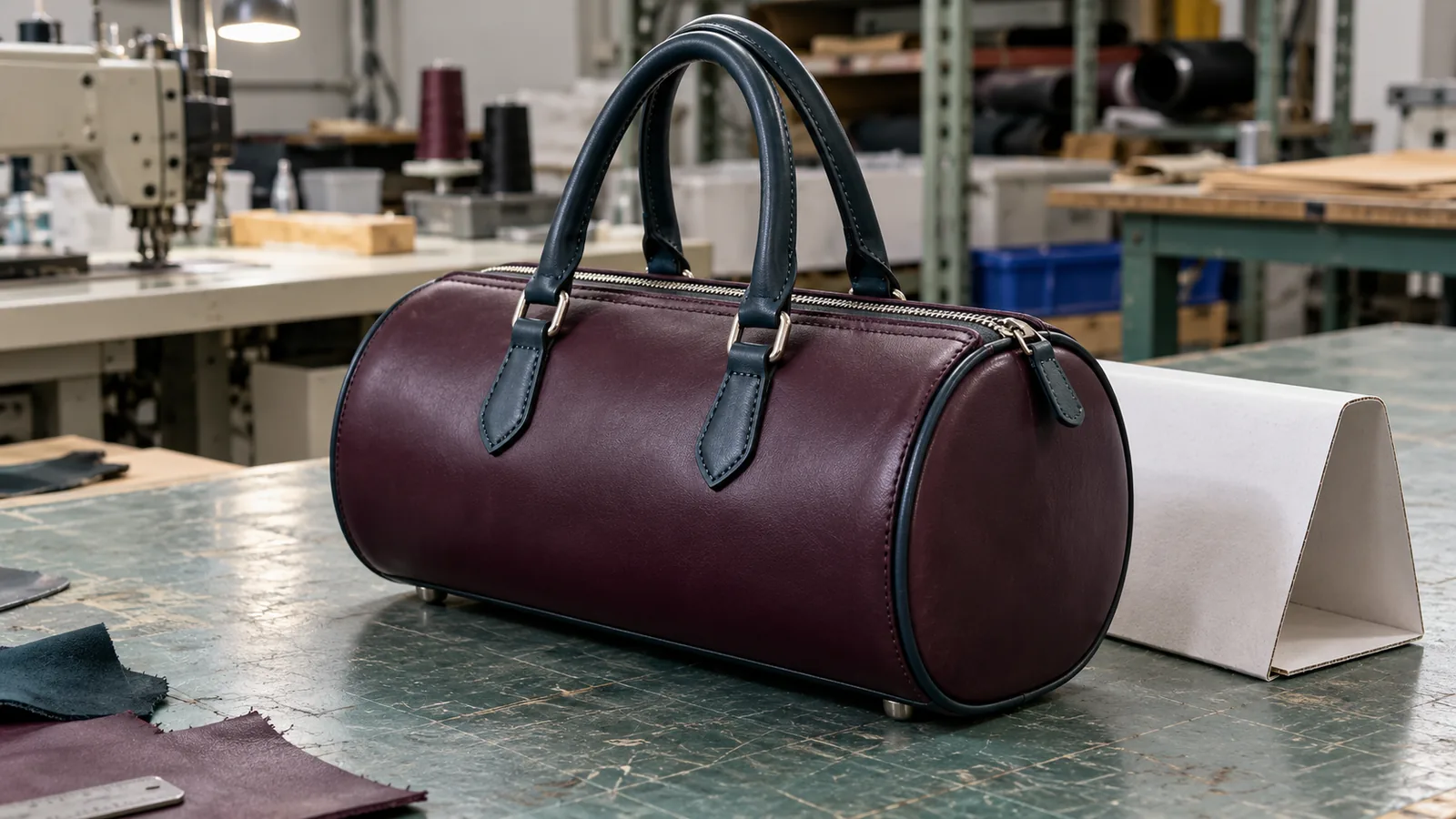
An elongated rounded handbag cannot be specified reliably with a front photograph and a category name. “Bowling bag” and “barrel bag” are used differently across markets and supplier catalogs; they should not be treated as universally interchangeable. Begin with the visible silhouette and construction relationships, then state which name your range will use.
Practical bowling barrel bags wholesale specifications define the long profile, curved end panels, opening, handles, base and packing together. A change to one area can alter the others: a zipper that extends farther into the ends changes access, an anchor placed high on a curved panel affects presentation, and flat packing can distort a body that was approved with a rounded profile. The buyer's job is to make those decisions traceable before quotation and sampling.
Name the Scope, Then Show the Intended Silhouette
Use the product name as a commercial label, not as a pattern instruction. In this guide, barrel describes a distinctly cylindrical or tube-like direction, while bowling covers an elongated handbag with rounded upper corners or ends and paired handles. A project may combine features from both, but the drawing and measurements must show the intended result.
Send front, side/end, top and base references. Mark the longest body width, overall height, maximum depth, top-line length and the point where curvature begins. Explain whether the base should read flat and stable, softly rounded, or visually integrated into the long body. If a measurement is undecided, mark it estimated, provide a range or use TBC.
This scope is different from the Boston versus Doctor Bag guide, which compares two classic formats and their market positioning. It also goes beyond the general Top Handle specification guide. Here, the buyer is controlling the distortions and alignment issues created by a long rounded body, curved end panels and an extended opening.
Control the Long Profile and Curved End Panels
The end panel determines more of the silhouette than many front-view briefs acknowledge. Show whether it is circular, oval, D-shaped, softly rectangular or another approved geometry. Record its width and height, seam or piping route, orientation and relationship to the base. If the end narrows toward the top, include the top width and the widest point.
Ask how the proposed outer material and support create the desired profile, but keep the approval observable. “Structured” is not enough. The sample should be photographed empty from both ends, from above and at a low front angle. Compare the left and right curves, seam position, piping continuity and the way the top settles when the handles are released.
When the bag uses separate long body, end and base panels, show where each join should appear. When a supplier proposes a wraparound panel, ask for a construction explanation and sample evidence. Do not claim that one method retains shape better unless the project includes an agreed test and result.
Material direction also affects visual continuity. Review genuine leather sourcing considerations or vegan leather options as relevant, then confirm the actual material, thickness or hand-feel direction and color reference for the project. A material-category page does not establish the composition, availability or performance of a specific bag.
Map the Opening Across the Curved Body
Decide whether the zipper remains on the top line, follows the shoulders of the bag or extends into the end panels. Mark its start and finish, the intended open position, end-tab treatment and any double-puller meeting point. The open bag should still be compared with the approved silhouette; a long zipper can improve access while allowing the sides to spread more than expected.
Specify the component appearance and operation direction: zipper tape color, teeth or coil look, puller, slider count and any cover or piping beside the opening. The handbag hardware material page can organize these component choices, but a finish name alone does not define the zipper or confirm performance.
During sample review, observe whether:
- the closed zipper follows the intended center or offset line;
- the ends finish at matching positions;
- lining, seam allowances or internal pockets obstruct travel;
- the mouth opens far enough for the intended use without unsupported fit claims;
- the top panel puckers or twists when the zipper is closed;
- the bag returns to the approved visual form after normal sample handling.
These observations approve appearance and function at the sample stage. They do not establish cycle life, water resistance, load performance or long-term shape retention.
Position Paired Handles and Their Anchors
Paired handles need a geometry brief, not only a handle-drop number. Record finished handle drop, width, total length, profile and edge treatment. Show anchor spacing horizontally and vertically, the attachment shape, stitch direction and any hardware connection. Confirm the clear space between the handles and the zipper when the bag is open.
On an elongated body, anchor positions can pull the upper panel inward or rotate the end panels. Ask for a front and end view while the sample is held normally, then review whether the body remains visually balanced. If a detachable long strap is included, specify its separate anchor locations, hook orientation, width and adjustment range. Do not assume top-handle anchors can also receive a shoulder strap.
Use the top handle bag collection as an assortment reference, not as evidence that every shown style shares this construction. For a new pattern or significant geometric change, route the brief through handbag product development.
Define the Base Without Making Unsupported Stability Claims
The base must be drawn in relation to the curved ends. Provide base length and width, corner shape, seam position, any separate panel direction and whether feet are requested. If the bottom should look flatter than the upper body, mark the transition zone rather than leaving the factory to guess where the cylindrical form ends.
Discuss the desired empty-bag presentation and whether an internal base insert, external feet or other support is being considered. Approve the proposed construction only after reviewing the physical sample. A base panel or insert does not prove a load rating, and feet do not guarantee surface protection.
The following matrix keeps the long-body systems connected:
| Relationship | Specify before sampling | Review on the sample | Escalate when |
|---|---|---|---|
| Body to end panel | End geometry, widest point, curvature start and seam/piping route. | Left/right profile, seam alignment and empty-bag silhouette. | The name and photograph still allow different panel interpretations. |
| Opening to body | Zipper path, end positions, pullers and desired open position. | Centering, corner travel, lining clearance and top distortion. | The opening change requires new panel geometry. |
| Handles to opening | Drop, width, anchor spacing, attachment and zipper clearance. | Balanced presentation, access and anchor alignment. | The anchors interfere with the zipper or pull the upper body. |
| Base to curved ends | Base dimensions, join, support direction and feet if requested. | Transition shape, panel alignment and approved empty posture. | A flat base changes the intended long rounded profile. |
| Packing to silhouette | Insert, handle position, unit protection and carton orientation. | Unpacked appearance and any pressure at ends, top or base. | The proposed pack flattens or creases approved form zones. |
Match Interior Layout to a Long Opening
Interior decisions should follow the body and opening. Specify lining color and material direction, pocket type and dimensions, label position, any divider and the location of seam allowances. A long bag may tempt buyers to add many pockets, but every pocket must remain reachable through the actual zipper mouth.
Ask for open-interior photographs from both ends. Check that pocket openings do not disappear under the upper curve and that a divider does not force the body into a different silhouette. If an intended item or organizer must fit, provide its dimensions and verify the physical sample; do not infer usable capacity from the exterior length.
Keep decorative and functional hardware listed by location. Confirm rings, feet, pullers, logo components and detachable-strap parts separately so the quotation and sample comments refer to the same component map.
Protect the Shape During Unit Packing
Packing is part of the specification because pressure on the ends, handles or top can change how this silhouette arrives. Describe whether the body should contain a removable shape-support insert or other agreed filling, how handles should rest, how hardware should be separated from the surface, and whether a dust bag or retail component is required.
The proposed support should be easy to identify and remove without implying that it guarantees shape retention. Ask for a packed-unit photograph and an unpacked review after the agreed handling stage. The image for this article is an illustrative concept, not a packing standard or proof of transport performance.
If branded or project-specific unit packing is required, review the custom handbag packaging service and provide artwork, component descriptions, placement and destination needs. Carton quantity, dimensions, weight, price and shipping timing remain project-specific and require confirmation.
Choose a Sourcing Route and Prepare the RFQ
For an existing or Ready Stock style, send the exact item reference and ask for current dimensions, materials, colors, quantities, construction, branding options and packing. Inspect the actual item against your required long profile. Do not assume the category name confirms its geometry or that current availability matches an earlier response.
Existing-style customization may allow selected changes to logo, color, material, lining, hardware or packaging. Ask which changes preserve the underlying pattern. A new end-panel curve, zipper path, base or anchor position can move the project into development.
For OEM development, prepare one RFQ package containing:
- the chosen product name and a plain-language silhouette definition;
- front, end, top, base and open-interior references;
- width, height, depth, end-panel geometry and measurement points;
- zipper path, pullers, end treatment and desired access;
- handle dimensions, anchor spacing and any detachable strap;
- base construction direction, feet or support for review;
- material, lining, pocket, logo and hardware directions;
- packing support, unit protection and retail components;
- quantity by style/color, or estimate/range/TBC;
- destination market and all unresolved decisions.
MOQ depends on the confirmed material, construction and customization scope. Price, sample cost, timing, packing and delivery basis also require an actual project review. A detailed brief improves quotation comparability; it does not create fixed commercial terms.
Frequently Asked Questions
Are bowling bags and barrel bags the same product?
Not universally. Catalog language varies. Define the actual silhouette, end panels, opening, handles and base, then state the commercial name you intend to use.
Should the zipper extend into both curved ends?
Only if that route supports the desired access and appearance. Mark the start and finish, then review opening behavior, symmetry, lining clearance and body distortion on the sample.
Can I approve the shape from a stuffed sample?
Review the approved packing state, but also inspect and photograph the empty sample. Packing material can hide differences in panel geometry or support, so the specification should identify the intended empty-bag presentation.
What quantity should I provide before all specifications are final?
Provide your best estimate, range or TBC by style and color. It gives commercial context without being treated as a confirmed order or fixed MOQ.
Send the Profile for Feasibility Review
Send front, side/end, opening and base references together with the handle direction, material choice, interior needs, packing expectations and quantity context. Christori can review which sourcing route and specification questions fit the project, while construction and commercial facts remain subject to confirmation.