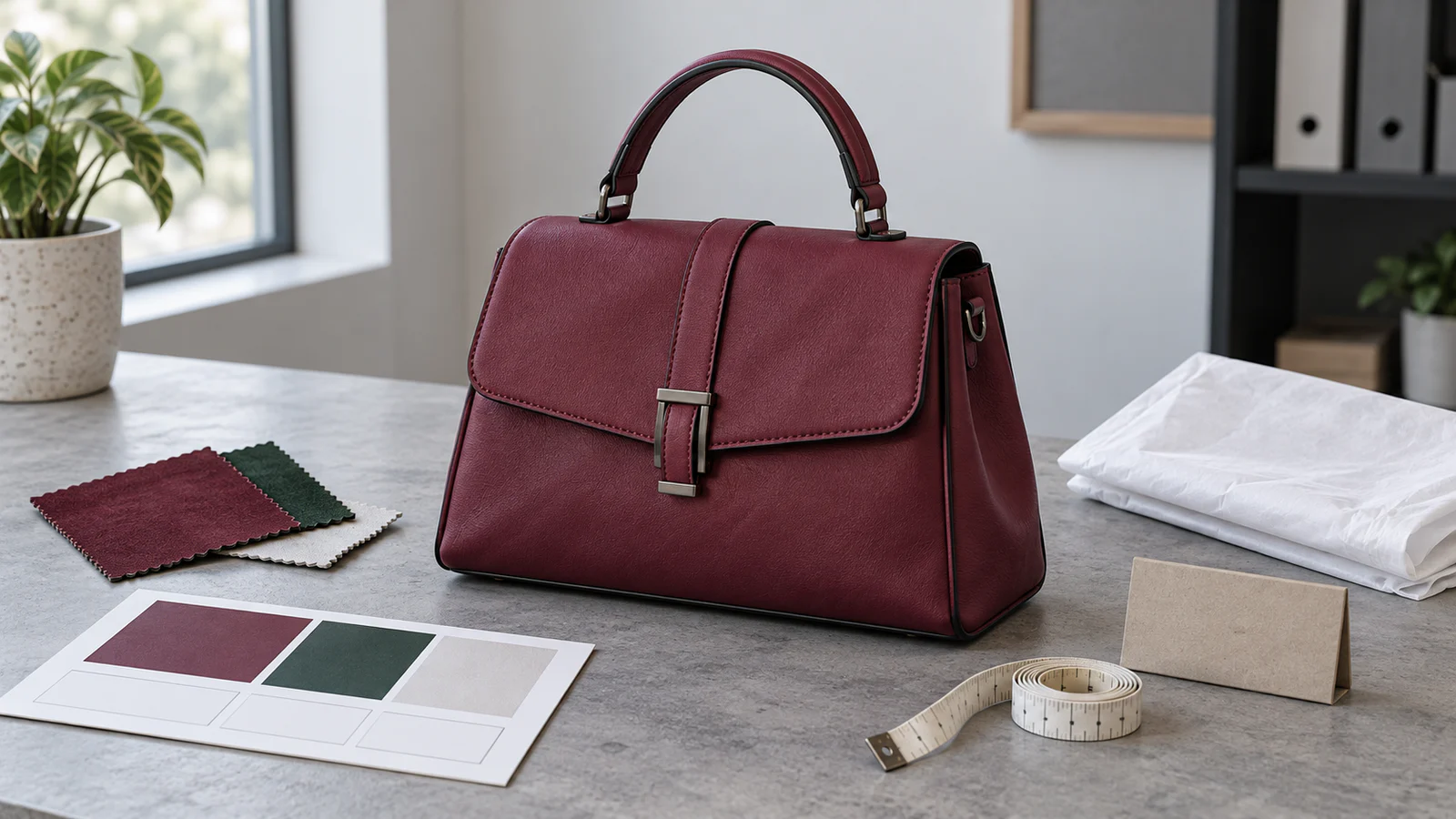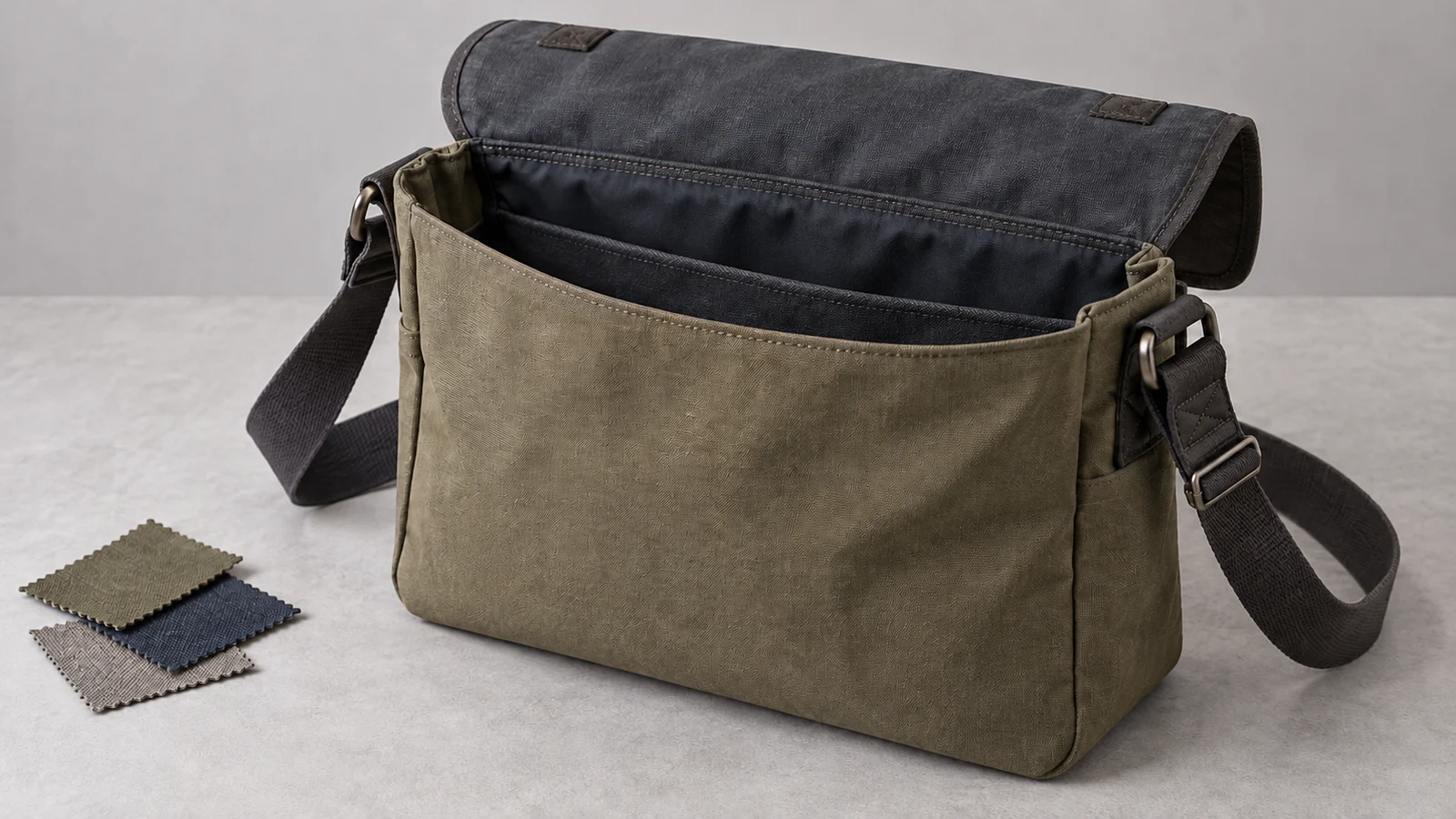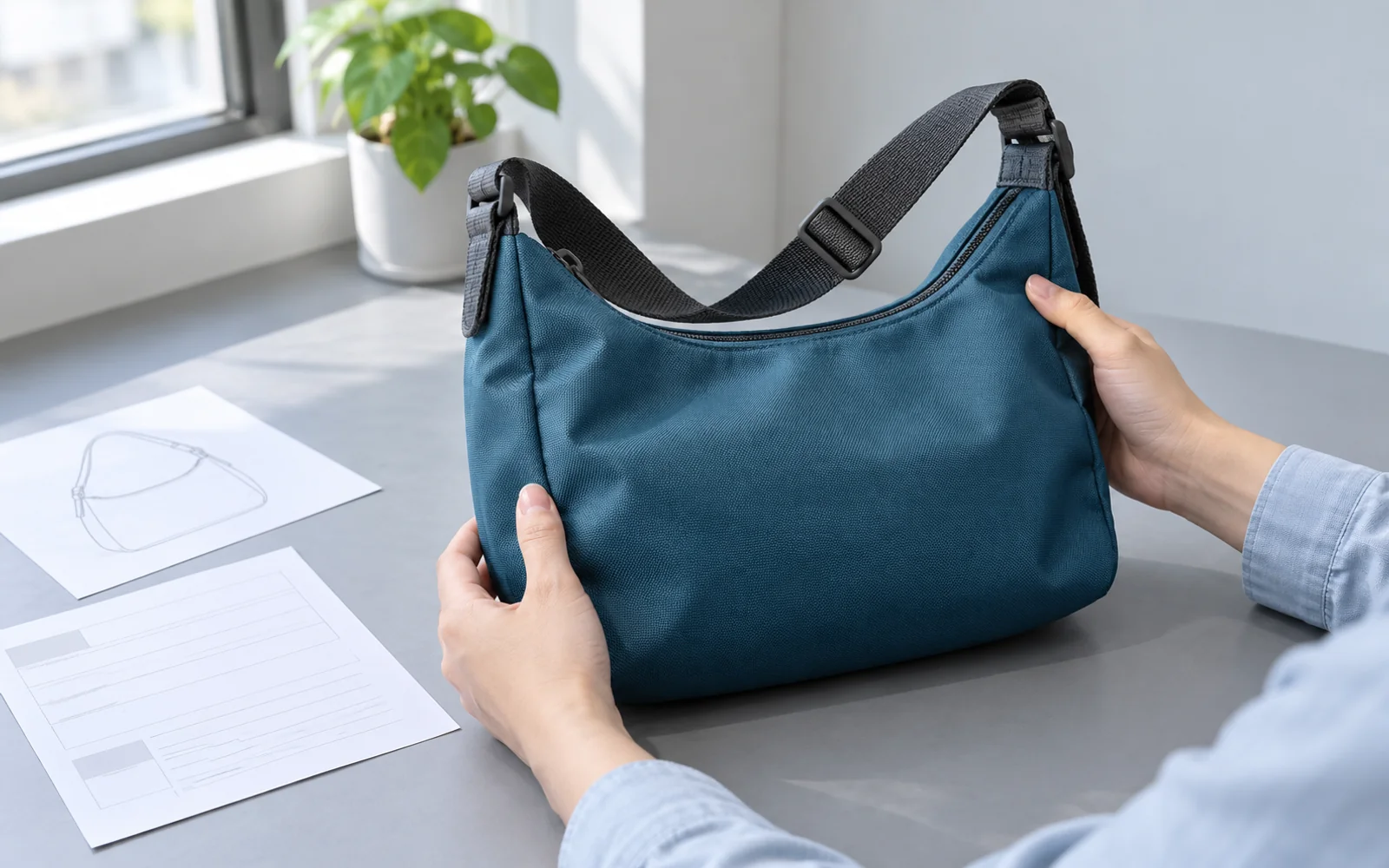
Your first custom nylon shoulder bag sample has arrived. The body looks different when suspended, one zipper edge appears wavy, and the lining gathers near an opening. Sending "please improve the finish" leaves the factory guessing which observation matters and what you expect to see next.
A useful revision note identifies the location, review state, photo angle, visible behavior, expected result and priority. It gives the factory something to reproduce and investigate without asking the buyer to diagnose production from a photograph.
This guide starts after sample receipt. If the material direction is still open, review nylon material options for custom handbags or compare canvas and nylon before sampling separately. Here, the task is narrower: describe the sample in front of you and decide what needs clarification before a revision is approved.
Fix the Review Conditions Before Comparing the Sample
Identify the sample version and reference used for review. Keep the original photos together before adding arrows or comments. Agree what "left" and "right" mean, such as the buyer's view of the front, so an interior photograph does not accidentally reverse the requested change.
Record whether the bag is empty, resting flat, standing, suspended, open or closed. If agreed contents are used, list them. Do not compare an empty first sample with a filled revision and conclude that the shape has improved. There is no universal load or tolerance implied by this visual review.
Use consistent daylight and a repeatable camera position. Capture front, side and interior views before moving closer to a concern. Keep one full view that locates each detail. Avoid pulling the panel smooth for one photograph while letting it relax in another without noting the difference.
On the revised sample, repeat these conditions. Where a setup cannot be reproduced, say so rather than treating the two photographs as directly comparable.
Record Wrinkles and Seam Puckering Without Guessing the Cause
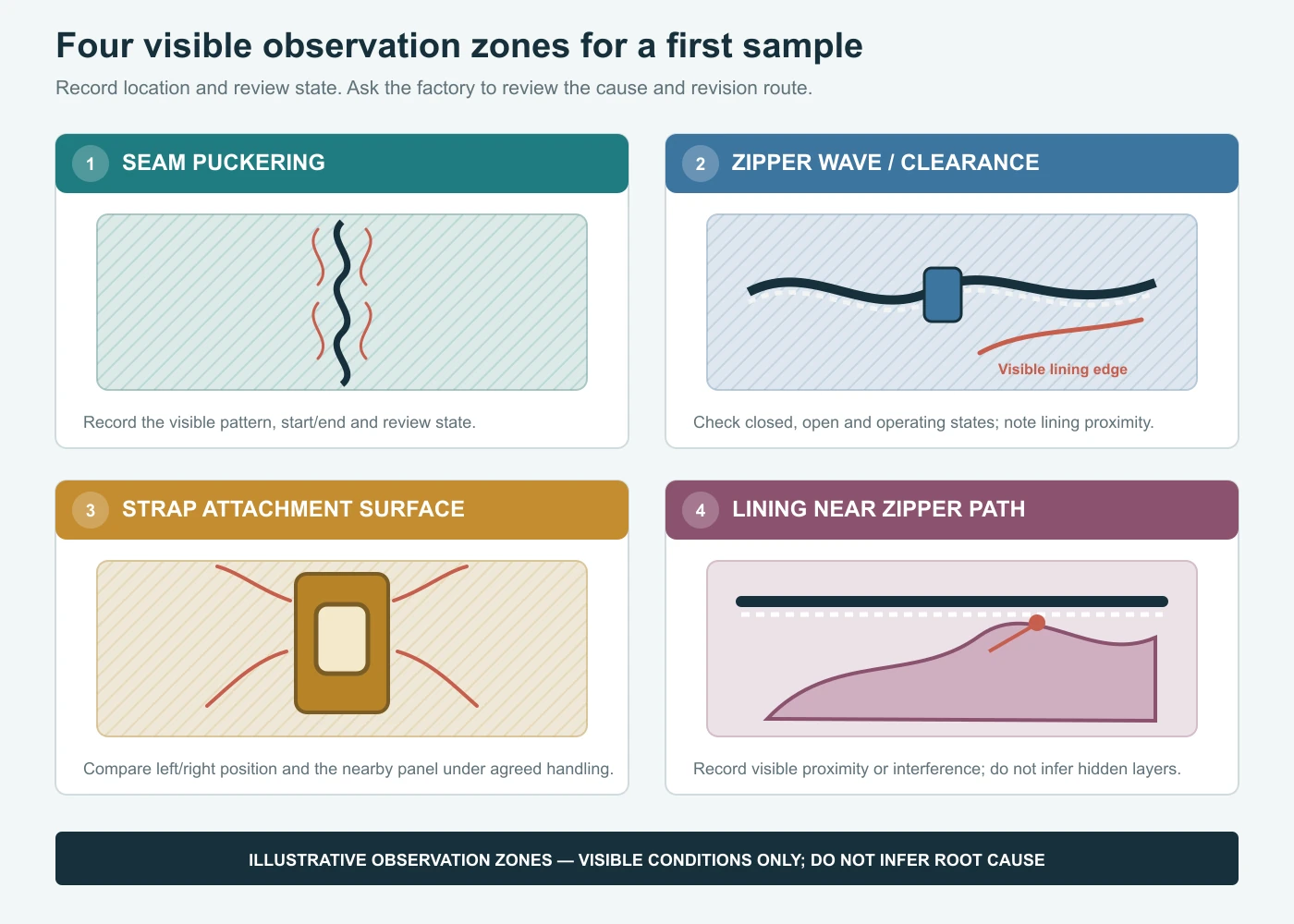
Start by locating the change in surface. A loose fold across a free panel is a different observation from repeated gathering directly along a seam. A cluster at a corner also needs a more precise note than "the nylon is wrinkled."
Mark where the visible change begins and ends. Compare corresponding areas on the other side, and note whether it appears while resting or only when the bag is held. If a fold disappears after the handling state changes, record both states; do not remove that information by selecting only the most dramatic photograph.
Coats' technical explanation of seam puckering identifies several possible contributors, including fabric structure, seam construction, thread and needle selection, and feeding. More than one may be involved. That supports asking the factory to investigate, not naming thread tension as the confirmed cause from a photo.
Keep the buyer's note descriptive: "Observed along the marked front seam. Appears when the empty bag is suspended. Expected appearance follows the agreed reference. Please review the affected area and explain the proposed revision." Avoid prescribing a needle, stitch setting, different fabric or added support before the construction has been reviewed.
Whether the appearance is acceptable depends on the intended design and agreed reference. Not every visible fold should become a defect ticket, but every requested change needs a clear location and target.
Check the Zipper Edge in Both Appearance and Use
Photograph the complete opening with the zipper closed, then open. Note whether a wave continues along the edge, is confined to an end or changes when the bag is suspended. Compare both sides under the same setup. A close-up should supplement this context, not replace it.
Then observe ordinary opening and closing as agreed for the sample review. Record where the slider encounters resistance or nearby fabric enters its path. If movement is obstructed, stop rather than forcing it, and identify the position in a photograph or short video. Distinguish "resistance near the left end" from a general claim that the whole zipper is defective.
YKK Japan's zipper sewing guidance explains that a slider needs room to travel and that nearby fabric, particularly lining, can be caught or make operation heavier. This supports inspecting the operating path; it does not supply a universal clearance measurement for your bag.
Record appearance and operation separately. A wavy-looking edge and an obstructed slider may occur together, but that does not establish one cause. Ask the factory to review the integration and propose what the revised sample should demonstrate. These technical references do not indicate that Christori uses Coats or YKK components, or that this sample has passed a performance test.
Observe the Shoulder-Strap Attachment Area Under Agreed Handling
Use the baseline view to compare the two attachment points: their apparent height, angle and the surrounding panel shape. Check that the camera is not tilted before reporting a mismatch. Identify whether the concern is visible at the attachment itself, in nearby fabric or in the orientation of the hardware.
Under the agreed gentle holding or suspension condition, watch for a new crease, local pulling or a changed outline. Record where the strap is held and the bag's contents or empty state. Use the same setup for both sides rather than pulling one side more firmly to exaggerate a difference.
A surface photograph cannot establish the hidden backing, number of layers or internal stitching arrangement. Ask the factory which area it proposes to review and how the revision can be observed again. Do not request an unseen reinforcement change as though the existing construction were already known.
Keep this decision separate from strength approval. A straighter-looking connection is an appearance observation, not evidence of a load rating or durability. Any required performance evaluation needs its own agreed basis beyond these photographs.
Separate Lining Interference From Outer-Shell Appearance
Open the bag enough to show the interior without stretching it into a different shape. Locate lining that bunches near an opening, pulls around a pocket, shows outside the intended edge or approaches the zipper path. Note whether the pocket or closure is open or closed when the concern appears.
Record the visible lining and outer shell separately. Hidden support is another question, not another name for lining. If an internal fold and an external crease appear in the same state, document their positions and timing. That is an observed association, not confirmation that one caused the other.
Use handbag lining and interior options when the discussion concerns the interior specification. If the desired body behavior itself remains unclear, define structure and reinforcement before sampling before turning it into a revision instruction. Avoid mixing an unresolved design preference with a complaint about the delivered sample.
Keep an interior overview and a marked detail together. Ask the factory to clarify what is visible and what requires construction review; do not open seams or remove layers simply to make the photograph more conclusive.
Turn Each Observation Into a Revision Ticket
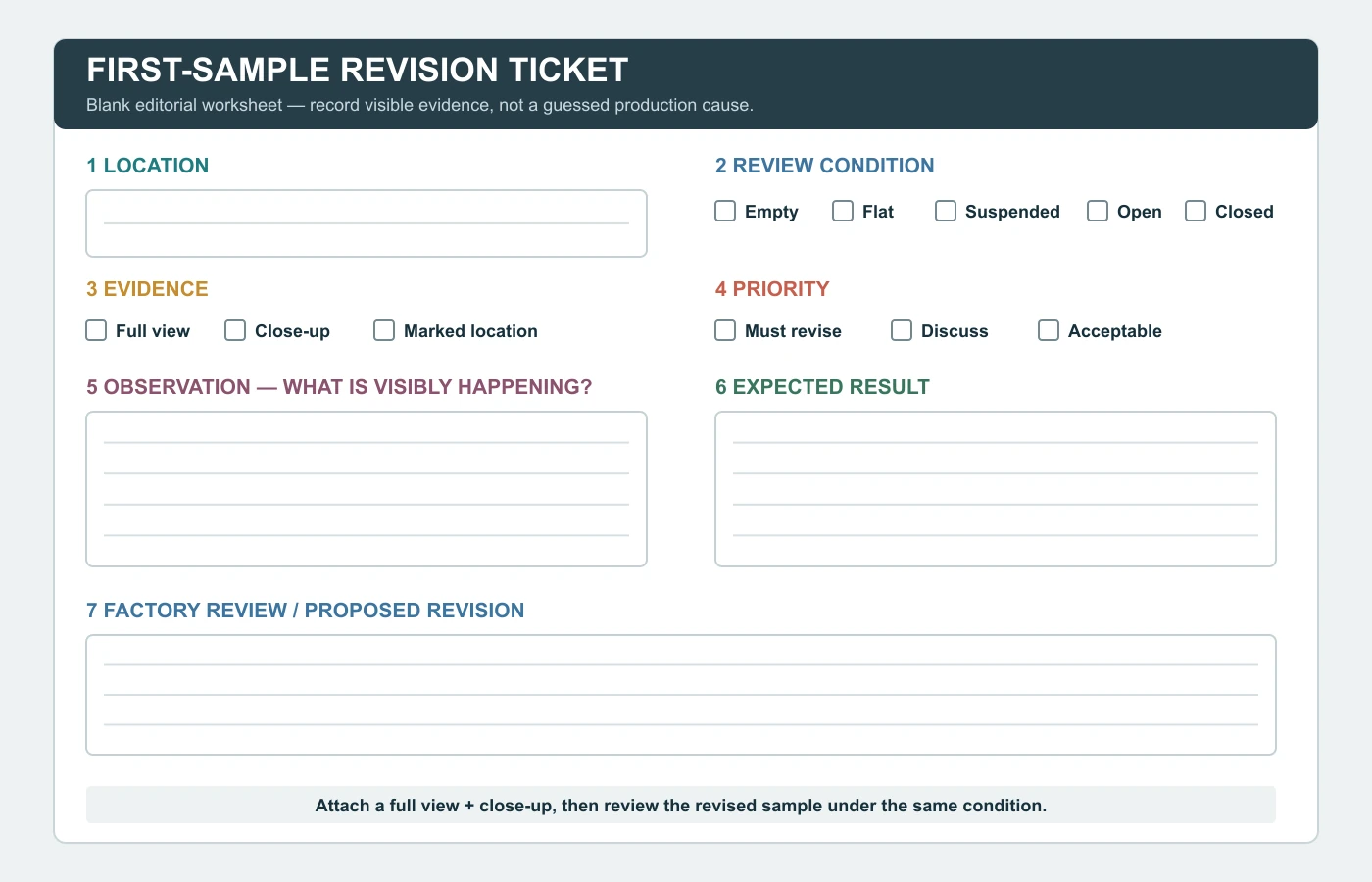
Use one numbered ticket per issue. Connect its number to the full-view image and detail photo, and identify the sample version. This prevents a later reply about a zipper end from being mistaken for approval of the entire opening.
| Field | Buyer records | Do not assume |
|---|---|---|
| Location | Named panel, seam, zipper end, strap anchor or lining area | Hidden construction is known |
| Review state | Empty or agreed contents; resting, suspended, open or closed | One universal loading condition |
| Evidence | Full view, marked location and close-up with matching photo IDs | A dramatic close-up explains the whole issue |
| Observation | The visible change or operating behavior | A confirmed production root cause |
| Expected result | The reference appearance or behavior to review again | A machine setting or material substitution |
| Priority | Must revise, discuss or acceptable for the stated point | Every difference is a defect |
Editorial example, not a customer project or Christori factory record: Location: left zipper end. Condition: bag empty and zipper closed. Observation: repeated waves extend through the marked section, and the lining approaches the slider path. Expected: the zipper edge should follow the approved reference without lining interference. Please review the construction and propose what should change for the revised sample. Priority: discuss the proposal before revision approval.
Attach both views rather than relying on this text alone. Leave measurements blank when they have not been taken; an approximate-looking distance in a photograph is not an agreed specification.
Consolidate comments from design and sourcing into one version. If one reviewer wants a softer silhouette and another asks to remove every fold, resolve that conflict before sending instructions. Ask for a response against each ticket, including what needs clarification and what the factory proposes to review. When the revision arrives, compare the same views and record each point as resolved, still open or needing discussion; do not let one improved detail close unrelated tickets.
First-Sample Review Checklist
- Record the sample version, reference, viewing direction and review conditions.
- Save front, side and interior baseline photographs before marking details.
- Locate panel, seam and corner observations, comparing corresponding areas under the same conditions.
- Review the zipper closed, open and during operation; record any lining near the slider path.
- Compare both shoulder-strap attachment areas using the agreed handling and contents.
- Separate outer-shell observations, visible lining and questions about hidden support.
- Give every requested change a location, state, photo reference, observation, expected result and priority.
- Recheck the revised sample under matching conditions without presenting visual review as a strength or durability result.
Before sending the notes, remove any unsupported cause from the observation field. Keep it as a question for the factory if it still needs investigation.
Frequently Asked Questions
Does every wrinkle mean the nylon fabric is wrong?
No. Locate the wrinkle and record the state in which it appears. A photograph alone cannot identify whether the fabric, assembly or another factor is responsible. Compare the intended appearance before requesting a change of material.
Is a wavy zipper always a zipper defect?
No. Document its appearance and operation separately, then ask the factory to review the surrounding material, assembly and zipper integration. Record interference when observed, but do not treat it as a complete root-cause diagnosis.
Can buyers approve strap attachment strength visually?
No. Visual checks can reveal misalignment or changes in the surrounding surface. They do not establish load capacity or durability, even when the revised attachment looks more even. Keep performance requirements separate.
Should lining and support be treated as the same layer?
No. Visible lining and hidden support need separate identification. Describe what you can see, and ask the factory to clarify the construction where necessary. Do not infer an internal layer from an external crease.
Send a Reviewable Revision Brief
Clear feedback lets the next conversation focus on a reproducible issue rather than a disputed photograph. Keep the sample identity, observation conditions and reference images with the numbered tickets. Ask for clarification where the target or proposed change is still open, and reserve approval for the points actually reviewed. A better-looking photograph alone does not close the full revision list or establish product performance.
Send your nylon shoulder bag reference, target shape, first-sample photos and marked revision notes. Christori can review what still needs clarification before the next sample.