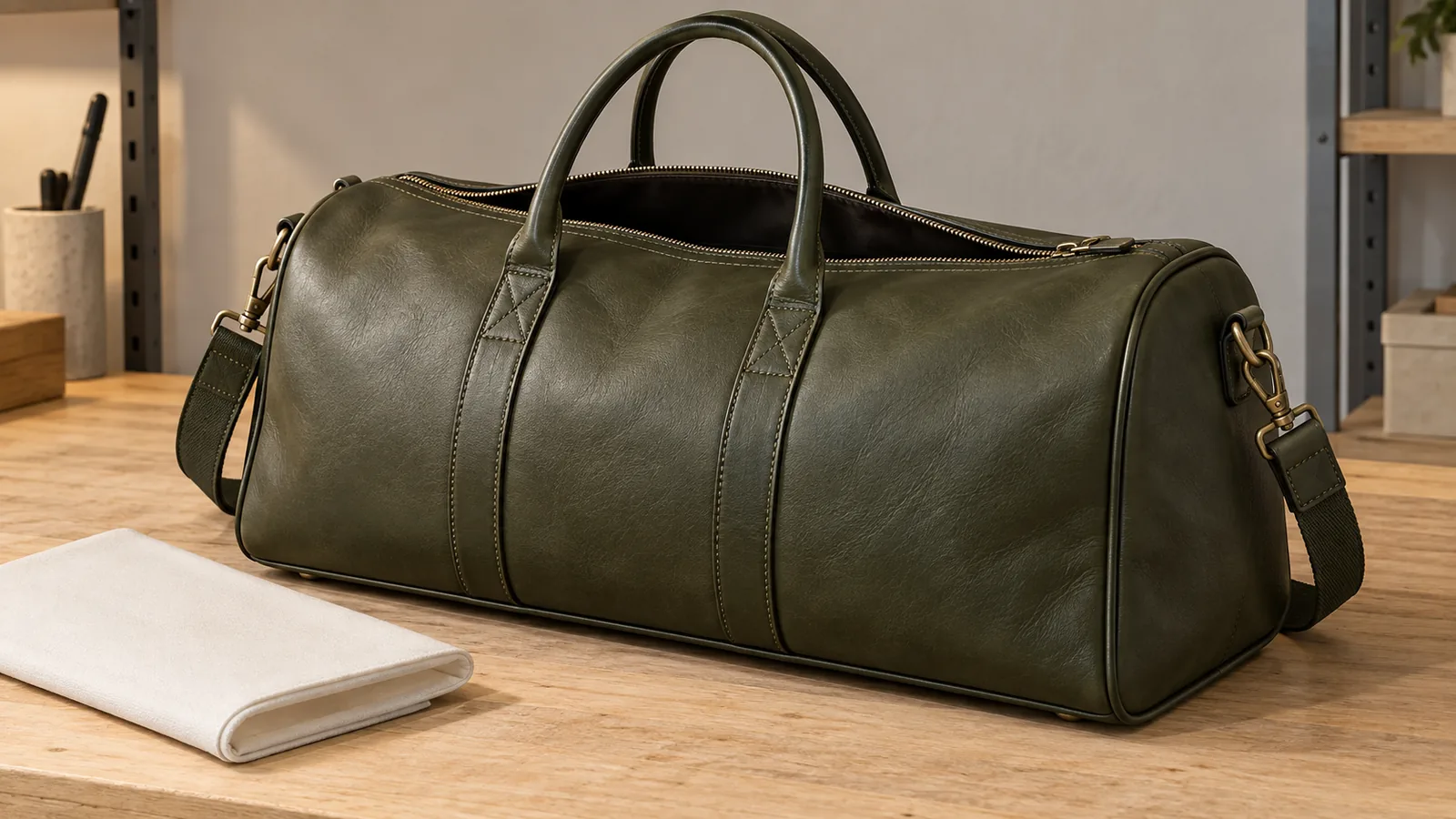
A buyer can select a leather duffle or weekender silhouette in minutes and still send an RFQ that is impossible to compare. Exterior dimensions alone do not define the opening, end-panel shape, handle connection, detachable-strap system, base support, interior or packing. If suppliers make different assumptions about those details, the resulting prices and samples do not describe the same bag.
Effective leather travel bag wholesale specifications translate the reference into a product scope: named measuring points, a usable opening, a defined carry system, material and trim direction, base and lining decisions, hardware, internal layout and shape-protecting packing. Early quantity can be an estimate, range or TBC. The actual material, construction, MOQ, price, sample cost and timing require confirmation against the reviewed brief.
This article has a narrower job than the Boston versus Doctor bag comparison, which helps buyers distinguish classic silhouettes, and the laptop-bag guides, which focus on device fit. Here the selected travel format is already known. The work is to specify its opening, carrying structure, base, interior and packing.
Define the Travel Format and Measuring Condition
Begin by stating what the buyer means by “duffle,” “weekender” or “travel bag.” Naming varies across suppliers and markets, so attach front, side, end, top and open-interior references. Explain which visual traits are essential: an elongated body, curved end panels, a wide top opening, paired handles or a detachable shoulder strap, for example. Do not assume the name alone fixes the construction.
Record finished body width, height and depth using marked points. For a soft bag, also state whether measurements are taken empty and naturally settled, lightly supported or filled to an agreed reference shape. Provide the opening length and the distance the mouth can practically spread without forcing it. If fit for a specific insert or object matters, provide that object's dimensions and clearance separately.
Do not present the article or a concept image as an airline-size reference. Carrier rules, measurement methods and buyer requirements can differ. If external dimensional compliance matters, the buyer must supply the applicable requirement and verify it independently for the target use.
The Top Handle Bags collection can help communicate adjacent carry formats, while Backpacks may help when the range includes hands-free travel products. Those pages are assortment references, not confirmation that a particular travel-bag construction is stocked or available.
Design the Opening Around Access and Shape
The opening affects packing access, zipper geometry and the bag's upper profile. Specify whether the zipper should run only across the top, extend into the end panels or follow another route. Mark start and stop points and show the target appearance in both open and closed states. A longer zipper path may improve access but also changes the end-panel and seam relationships that require factory review.
If the design includes two zipper sliders, a flap, snap tab or lockable-looking pull arrangement, list each component without assuming its exact hardware. Identify whether the pulls should meet at the center or another point and how loose ends should rest. The hardware material guide can organize finish and component questions; the factory still needs to confirm the actual item, base material, finish, size and feasibility.
During sample review, place the bag in the agreed measuring condition and inspect the zipper route from both sides. Check whether the opening moves without obvious snagging, whether the lining enters the path, whether the two sides are symmetrical and whether the end panels distort beyond the approved appearance. These are observable sample checks, not proof of cycle life, load capacity or long-term performance.
Build a Carry System, Not Just Two Handles
Paired handles should be specified as a connected system. Record handle drop, finished width, center-to-center spacing, anchor length and position, edge finish, reinforcement proposal and the desired relationship between the handles when the bag is open. Show whether a handle wrap, keeper or grip is required and how it should be stored when not used.
If a detachable shoulder strap is included, define its adjustment direction, usable length range as a design target, width, end hardware, shoulder pad if any and attachment points. Ask the supplier to confirm the proposed anchors and reinforcement for the selected construction. Avoid publishing a load figure unless the project has a defined and evidenced test requirement.
Handle and strap hardware should be reviewed next to the body rather than from an isolated catalog image. Confirm scale, finish direction, orientation, visible branding restrictions and contact points. Watch for a clip, ring or buckle rubbing the leather surface in the natural resting position. If the supplier proposes an alternative component, retain both references and record which one the buyer approved.
Connect End Panels, Gussets and the Base
The body may appear simple from the front, while the end panels and base determine much of its three-dimensional shape. Ask for a side or pattern relationship drawing that identifies end-panel geometry, gusset seams, piping or edge treatment and the base transition. The purpose is not to dictate an unverified factory method; it is to expose the assumptions that influence shape and quotation.
The buyer should decide whether the empty bag is meant to remain structured, settle softly or hold only a moderate supported form. Then ask the factory to propose interlining or base support appropriate to the material and shape. Do not claim a universal support layer or construction method. The handbag structure and reinforcement guide provides broader planning language for support zones.
Use the table below to align the project scope before sampling.
| System | Specification input | Trade-off to review | Approval evidence |
|---|---|---|---|
| Silhouette | Front/end profile, dimensions and measuring condition. | Structured appearance versus a softer empty-bag presentation. | Dated views and agreed measurements from named points. |
| Opening | Zipper route, start/stop points, sliders and target clearance. | Wider access can change end-panel behavior and upper-edge support. | Open/closed photos and observable operation against the sample brief. |
| Handles | Drop, width, spacing, anchor position and grip/keeper details. | Comfort direction, opening clearance and visual scale must work together. | Measurement record plus front, side and underside anchor views. |
| Shoulder system | Detachable or fixed route, adjustment, pad and attachment points. | Added hardware affects weight, surface contact and packing arrangement. | Approved component references and a complete attached/detached view. |
| Base | Base dimensions, corner geometry, feet if requested and support direction. | Support can influence weight, foldability and empty-bag appearance. | Bottom view, side profile and supplier-confirmed construction proposal. |
| Interior | Lining, pockets, labels and opening-edge relationship. | More organization can add seams, bulk and assembly complexity. | Open-interior photos, pocket measurements and material approval. |
| Packing | Handle position, stuffing/support, surface protection and unit components. | Compact packing must be balanced against avoidable creasing or deformation. | Approved packing sample or documented sequence for this project. |
Specify Leather, Lining and Interior Organization
“Leather” is not a complete purchasing specification. Provide the material direction, supplier description if available, color, surface character, hand-feel target, thickness or weight reference where relevant, and approved swatch. Use the genuine leather sourcing page to frame the discussion, but do not infer grade, species, finish, origin or performance from a photograph or marketing name.
Consider how the material behaves across large panels, curved ends, piping, folded edges and handle anchors. The buyer can identify visual priorities such as consistent grain direction or a softer hand, while the supplier confirms what is feasible and what variation must be reviewed on the actual material lot. If contrast trim is used, specify it independently rather than assuming it matches the body material.
For the interior, state the lining material and color direction, pocket types, pocket measurements, zipper or binding details, label placement and any loose base board or removable component. The lining materials guide helps buyers compare planning factors. It does not establish composition, stain resistance, colorfastness or availability for a specific order.
Map internal pockets from stable seams. A phrase such as “one large pocket” is not enough to quote consistently. Provide finished width and height, opening direction, closure if any and intended object dimensions when fit matters. Review whether pocket seams or labels become visible through the exterior, particularly on softer panels.
Plan Packing as Part of Product Approval
Travel bags can lose their approved presentation if handles are sharply folded, detachable straps are placed against finished surfaces or unsupported ends collapse in transit. Packing should therefore be reviewed with the sample rather than added after product approval.
State the desired handle position, whether the strap is attached or packed separately, how hardware is isolated from the body, whether the bag is filled or supported, and which retail components are included. If a dust bag, tissue, shape insert, hangtag or branded packaging is requested, list it by revision and confirm whether it is included in the quotation. The custom handbag packaging service explains available project discussions without promising a fixed packaging solution.
Ask for a packed and unpacked review. Confirm that the proposed sequence is practical and that the bag returns to the approved presentation without avoidable hard creases. Do not state that a packing method prevents all deformation or surface marking. Actual carton data, shipping method and transit requirements remain project-specific.
Convert the Brief Into an RFQ and Sample Gate
The handbag product development route is relevant when the project requires a new pattern, opening, carry system or internal layout. A useful RFQ should include:
- Front, side, end, top, base and interior references with required features marked.
- Finished dimensions, measuring points and the condition used for measurement.
- Duffle or weekender silhouette direction and the features that define it for the buyer.
- Zipper route, slider count, opening clearance and closure details.
- Handle drop, width, spacing, anchors, keeper and edge-finish direction.
- Shoulder-strap range, width, pad, hardware and attachment-point direction.
- Leather and trim descriptions, swatches, colors and approved appearance references.
- Lining, pockets, label, logo and other branding inputs.
- Base support, feet or reinforcement direction where requested.
- Unit packing, surface protection, shape support and destination.
- Target quantity by style/color, or an estimate, range or TBC.
- Open decisions and the sample questions that must be resolved before bulk approval.
For the sample gate, review geometry first, then opening and carrying systems, then materials/components, then interior and packing. Record each comment against a photograph or measurement point. A final approval should identify the sample or revision it covers; “approved with changes” needs a closed list of changes before it becomes a production reference.
Frequently Asked Questions
Is a duffle bag the same as a weekender bag?
The names can overlap, but they do not create a universal construction standard. Define the intended silhouette, dimensions, opening, handles, strap, base and interior instead of relying on the label.
Can I request a quote before the leather is finalized?
Yes, if you clearly mark the material direction and unresolved options. The supplier can identify assumptions and alternatives, but a firm quotation still depends on the confirmed material, construction, quantity and customization scope.
Should travel-bag handles fold flat for packing?
Only if that behavior is part of the approved design and does not conflict with the handle construction. Show the intended packed position and ask the supplier to review it on the sample rather than forcing a generic folding rule.
Does an exterior size confirm airline acceptance or internal capacity?
No. Airline requirements and measuring rules must be checked for the target carrier and use. Internal capacity also depends on opening, lining, structure, pockets and panel shape; verify the actual sample against the buyer's requirement.
Prepare One Scope for Quotation, Sampling and Packing
A leather travel bag is easier to develop when the same document controls silhouette, opening, handles, strap, base, interior and packing. That gives the buyer a clear basis for comparing supplier responses and keeps sample revisions tied to visible decisions.
Share the travel-bag reference, dimensions, carry system, material direction and quantity. Christori can review the available brief, while feasibility, material, MOQ, price, sample cost and timing remain subject to project confirmation.