A wholesale work-bag range can look varied in photographs yet offer the same choice repeatedly. Several bags may share similar access, carry space and intended use, with only a different closure or surface detail. Buying all of them spreads the quantity plan without necessarily serving another customer need.
When sourcing commuter handbags wholesale, start with the role each style should play. Decide which workday you are serving, which format leads the range and what a supporting style adds. Then compare candidates against those decisions before committing to colors or custom development.
This is assortment planning for buyers, merchandisers and brand teams, not a list of recommended consumer purchases. The goal is a manageable group of distinct products that you can explain, sample and request quotations for on comparable terms.
Start With the Target Workday and Sales Channel
Describe the use situation before selecting silhouettes. Is the intended customer carrying documents between meetings, commuting with work equipment or taking a smaller bag on days with fewer belongings? Include the commute type, expected workplace presentation and whether hands-free carrying matters. These are requirements to investigate, not demographic assumptions about who buys a particular shape.
Next, define the selling context. A boutique buyer can compare physical samples together and consider how staff will explain the differences. An e-commerce team needs distinctions that remain clear in photographs, filters and product descriptions. A wholesale distributor needs a range that retail customers can select without decoding minor construction changes.
Set the intended price positioning as a buyer input, not a claim about what each format costs. Keep your sourcing budget basis consistent when comparing quotes; a bag-only figure and one including branding or packaging are not equivalent. Leave unknown costs open for quotation rather than using an assumed category price to decide the mix.
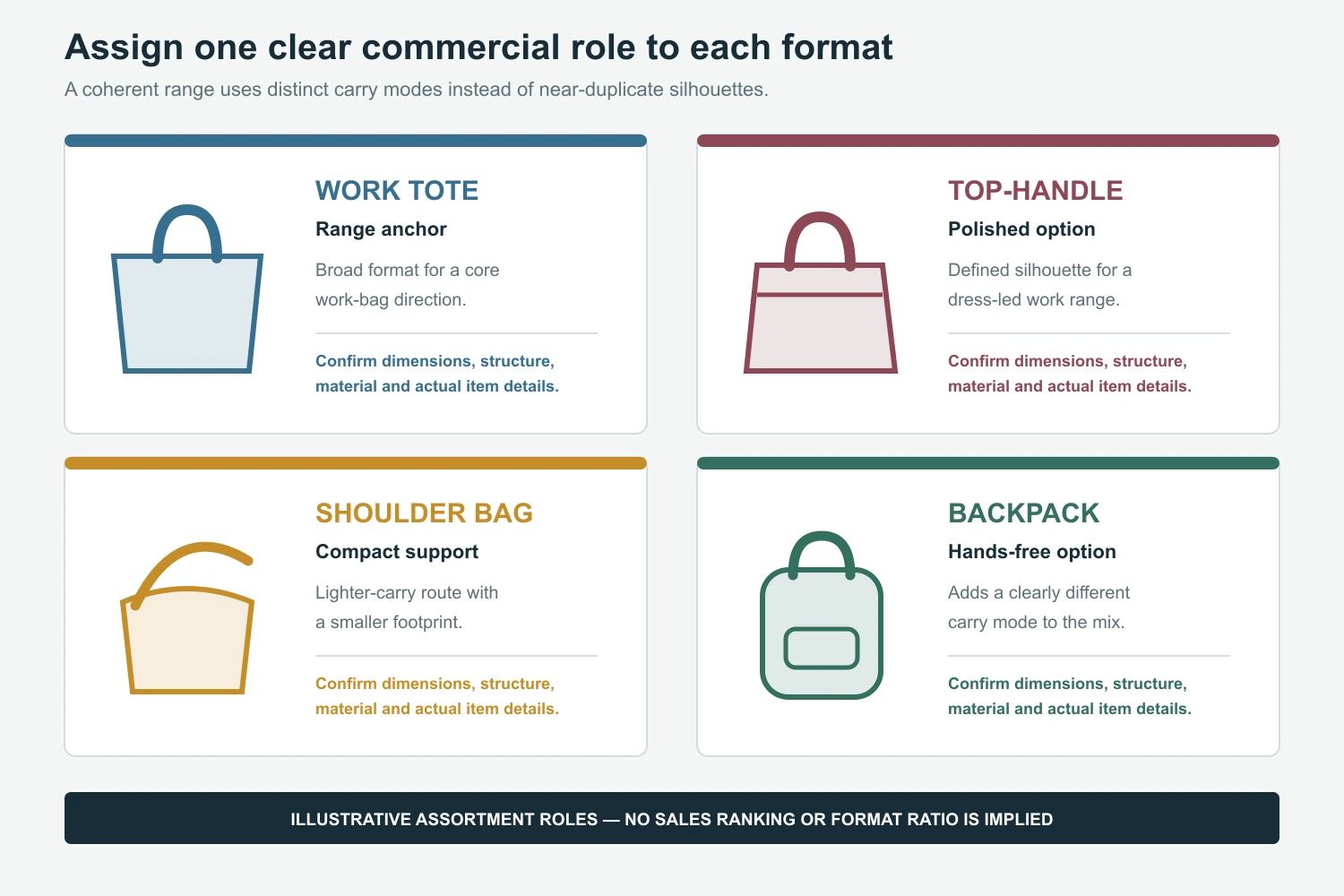
Assign a Job to Each Format
Formats are starting points, not promises. A tote is not automatically a laptop bag, and a backpack is not automatically more comfortable. Give each candidate a proposed role, then verify the actual style against it.
Tote: The Broad-Use Work Carry
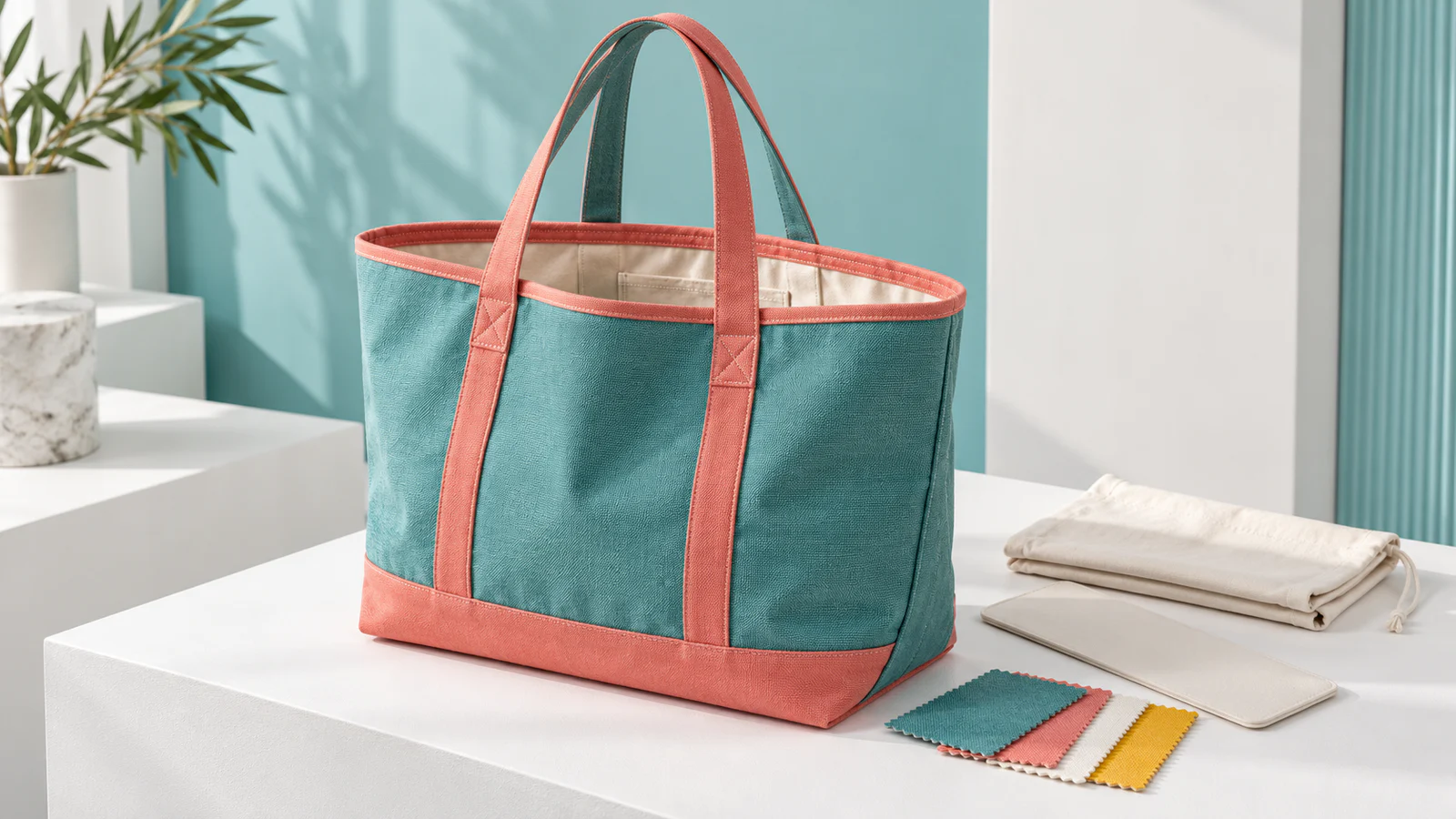
A tote can be the main format when the range needs flexible access and a relatively open interior. Browse tote bag directions for candidates, then decide whether each one covers a distinct carry requirement. Two totes with similar usable space and access may be competing for the same assortment role despite different exterior proportions.
Structured Top-Handle: A Presentation-Led Alternative
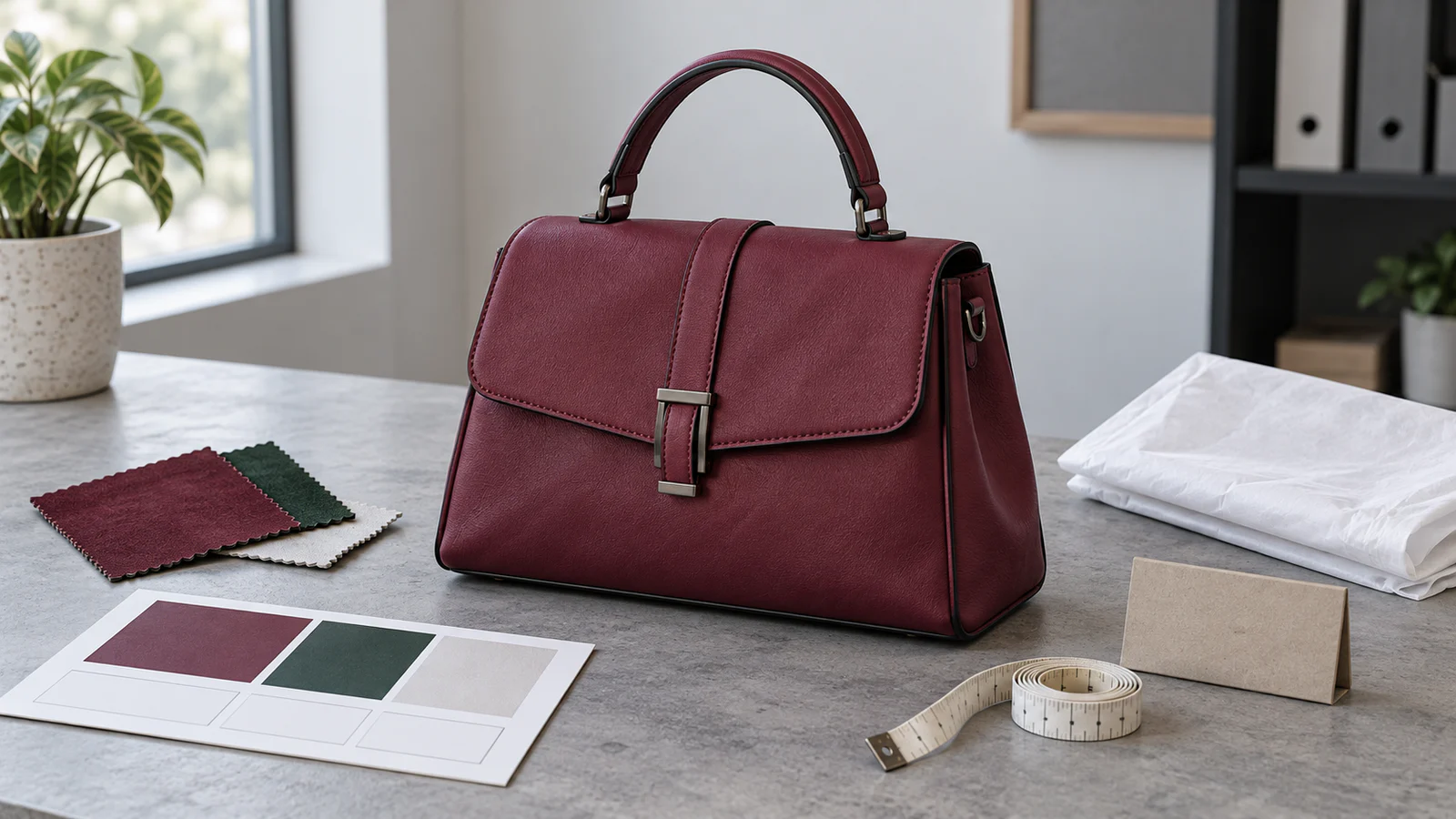
A more defined silhouette can provide an alternative when the brief prioritizes a composed appearance at work. Review the top handle bag collection as a format direction, not evidence of device fit or a specific internal construction. Keep detailed handle and opening decisions in the top-handle specification guide; here, decide whether that style adds a reason to choose it over the lead bag.
Shoulder or Crossbody: A Lighter-Carry Role
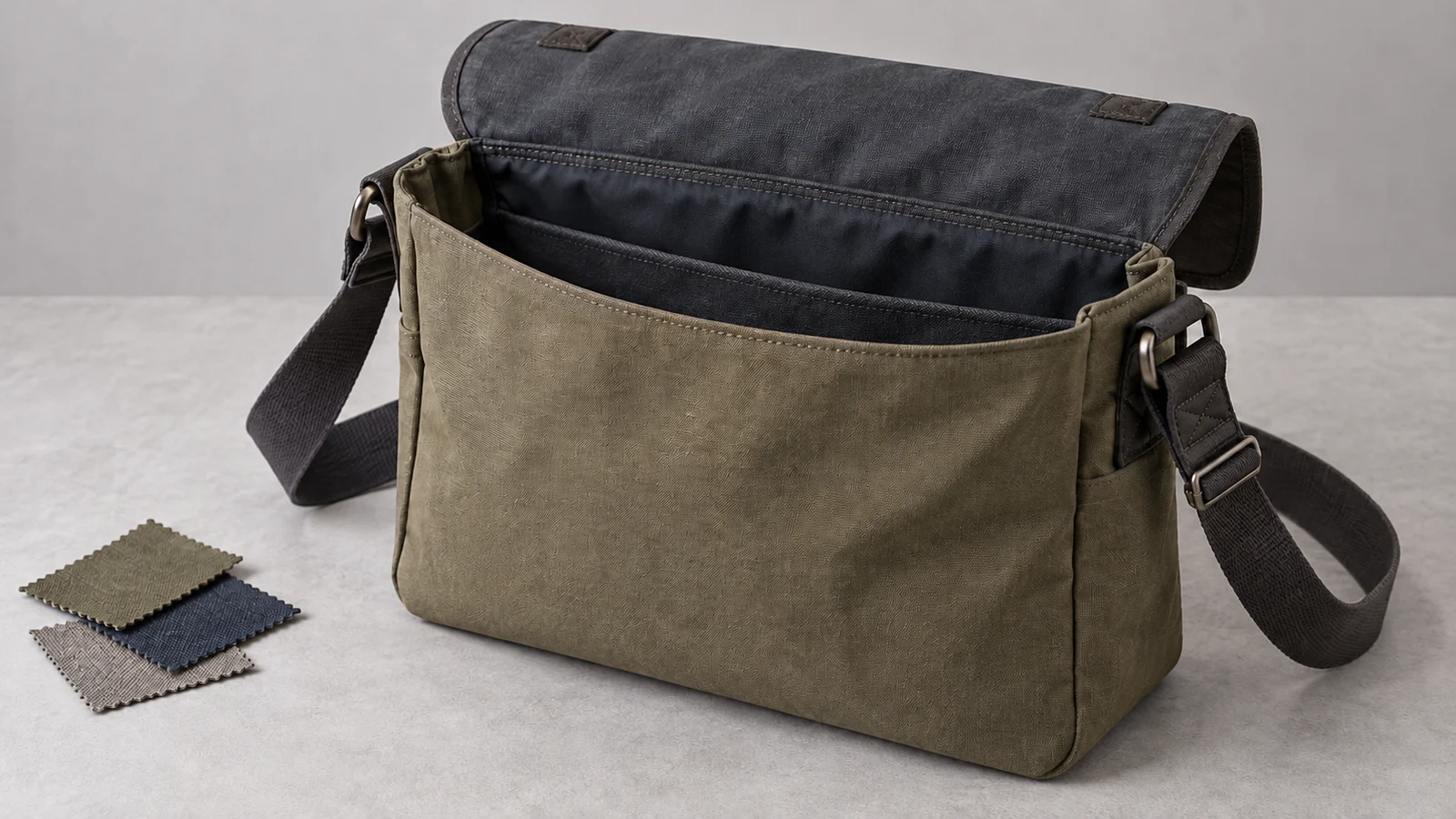
Consider a smaller carry requirement rather than promising a lighter product weight. A shoulder or crossbody candidate might serve a workday without the larger bag's contents. Shoulder bag options should earn their place through a different carry brief, access arrangement or silhouette. Confirm the actual strap configuration; a photograph does not establish crossbody usability.
Backpack: A Hands-Free Option
A backpack may add a carrying mode the other formats do not provide. Assess backpack candidates against the target workday and the rest of the range, rather than adding one solely to complete a category list. Review the actual carry arrangement and access with the sample. The category name establishes neither comfort nor protective performance.
| Format | Proposed assortment job | Evidence needed | Reason to reconsider |
|---|---|---|---|
| Tote | Main work carry with the required access | Usable space, opening and agreed contents | Another candidate serves the same brief |
| Top-handle | More defined presentation | Silhouette, access and carrying arrangement | Appearance changes but the buyer choice does not |
| Shoulder/crossbody | Different, smaller carry requirement | Actual strap setup and usable interior | No clear distinction from the lead format |
| Backpack | Hands-free carrying option | Access and sample handling for the intended use | The target workday does not call for it |
The matrix assigns questions, not rankings. Your range does not need all four formats. Remove a format when its proposed role cannot be explained without repeating another style's description.
Confirm Carry Requirements Without Guessing Capacity
List the actual contents expected for each role. Separate a device-carry requirement from a documents-and-personal-items requirement, and identify which details remain unconfirmed. Avoid assigning a laptop claim to every large-looking bag in the assortment.
Request the usable interior and opening measurements for shortlisted styles. If a device is involved, provide its actual dimensions and any case used with it. The handbag dimension guide can orient the measurement discussion, while the laptop-bag specification guide covers device-specific checks. Neither a size category nor a screen-size label replaces checking the selected bag.
Record an unresolved fit requirement as pending. That lets you compare the remaining assortment decisions without quietly turning missing information into a customer-facing promise.
Compare Structure, Opening and Organization at Range Level
Choose which differences matter across the range. An open-access tote and a zip-closed alternative may address different priorities, but only if those priorities are part of the target brief. More pockets or a firmer body are not automatically better reasons to add a style.
Ask whether a divider separates the intended contents usefully, whether a utility pocket is in the right place and whether base support suits the requested body behavior. A bottle pocket is a layout feature, not evidence of leak containment. Compare empty weight and handling using actual sample information instead of guessing from material names or photographs.
For unresolved panel support or shape retention, use the structure and reinforcement guide. Keep this assortment sheet focused on the outcome: what the buyer should notice when choosing between styles. Detailed construction approval belongs with the individual candidate, not in a repeated range-wide tutorial.
Set a Material and Hardware Direction
Decide whether the range shares one material direction or deliberately offers alternatives. Review genuine leather options and vegan leather options against the collection brief. Do not assume either route establishes a price tier, durability level or environmental claim. The selected material and supplier information need their own confirmation.
Coordination does not require every bag to use identical components. Establish which visible relationships matter: color family, surface character, hardware tone or interior presentation. Use hardware options and lining options to frame requests, then review the proposed selections together. Similar finish names do not prove an exact visual match across different components.
If one candidate needs a different lining or closure to work properly, decide whether that is an acceptable functional distinction. Do not force uniformity that removes the reason the style belongs in the range.
Build a Coherent Assortment and Remove Near-Duplicates
Choose a lead format because it addresses the primary brief, not because you can claim it will sell most. Assign supporting styles to requirements the lead does not cover. Give each a short internal description: "closed-access alternative" or "smaller carry for days without work equipment," for example.
Then review candidates side by side. If two styles share the same role, intended contents, carry mode and material direction, ask what the second adds. A different buckle might justify a visual option, but it should not silently become another full assortment commitment. Merge, defer or clearly distinguish that choice before adding colors.
Use a hypothetical planning check: a lead tote and another tote both target the same daily contents, while the brief also calls for hands-free carry. Before ordering both totes, review whether one duplicate should be deferred while a suitable hands-free candidate is assessed. This is a decision example, not a claim about demand or a recommended sales mix.
Build the quantity sheet by style and color. Keep core and exploratory selections identifiable, but do not apply a universal percentage split. For an existing business, use its own relevant order and sell-through records where available. For a new range without that evidence, label the assumptions and keep unresolved variants out of the committed selection until their sourcing terms are clear.
Review Samples as an Assortment
Individual sample approval and assortment approval answer different questions. A sample may meet its own brief but still duplicate another candidate. Review the group under consistent conditions and retain a decision for each style: keep, revise, defer or remove.
- Place the candidates together and check whether their intended roles are visible and explainable without reading supplier names.
- Use the agreed contents for each role. Do not judge one bag stuffed for presentation against another empty bag without recording that difference.
- Compare access, closure operation and interior layout against the assigned use, rather than awarding the same feature checklist to every format.
- Review color, surface and hardware relationships under the same lighting. Record deliberate differences separately from unwanted mismatch.
- Compare handling and actual sample weight where available. Avoid a comfort or capacity claim unsupported by the selected product review.
- Check the proposed branding and packaging references as a group, while noting any style-specific packing requirements.
- Return to the quantity plan. If a revision removes a style's distinguishing feature, reconsider its role before carrying its allocation forward.
These checks guide selection; they are not durability tests or a certification process. Keep any required technical validation separate and specific to the product.
Choose Ready Stock or Custom Development by Role
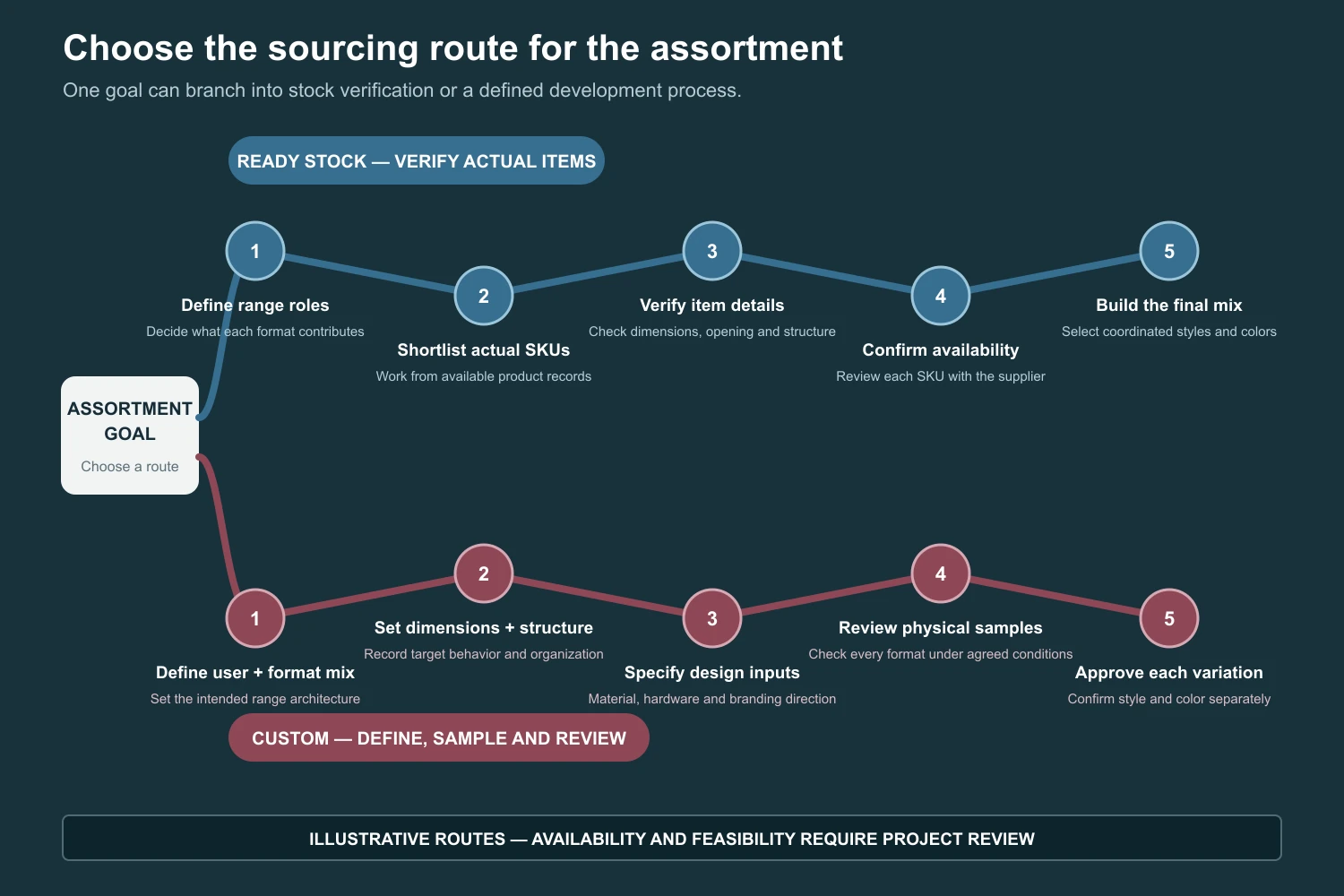
Ready stock sourcing starts with the actual offered styles, available variants and workable quantities. Curate what meets the brief, and verify the item before assuming its details can change. A coordinated appearance in the catalog does not confirm that every color is available together.
Existing-style customization may suit a candidate whose basic form works but whose branding or selected components need adjustment. Confirm those changes individually. Do not treat a different logo and a redesigned compartment as equivalent requests.
For a range that needs shared design decisions beyond available styles, discuss handbag product development. Identify what must be coordinated and what can stay style-specific. Quantity feasibility depends on the proposed material, construction and customization scope; custom-production references are not universal ready-stock minimums.
You may consider different sourcing routes for different roles, but keep their assumptions separate. Confirm availability, sample needs, quote scope and timing for each candidate before presenting the group as one executable order. A mixed-route plan is a proposal to review, not a commitment that all styles can ship together.
Prepare One Buyer RFQ Worksheet
Send a range brief plus a row for each candidate. The range brief explains the shared commercial direction; the rows identify what the factory actually needs to review. Mark open fields as questions instead of filling them with guessed specifications.
| RFQ field | What the buyer should provide |
|---|---|
| Target workday and channel | Intended user needs, commute context, sales channel and presentation direction |
| Assortment role and format | Lead or supporting role, carry format, reference image or current product link |
| Size and carry requirements | Known dimensions, measurement basis, expected contents and any device-specific information |
| Material direction | Outer material reference, surface/color preference and unresolved selections |
| Structure and interior | Required body behavior, opening, closure, dividers and useful pocket functions |
| Quantity plan | Proposed quantity for each style/color; flexible or exploratory choices marked separately |
| Branding and packaging | Logo requirements, shared presentation preferences and style-specific exceptions |
| Sourcing route and quote scope | Stock verification or development request, sample needs, delivery country and quote inclusions to confirm |
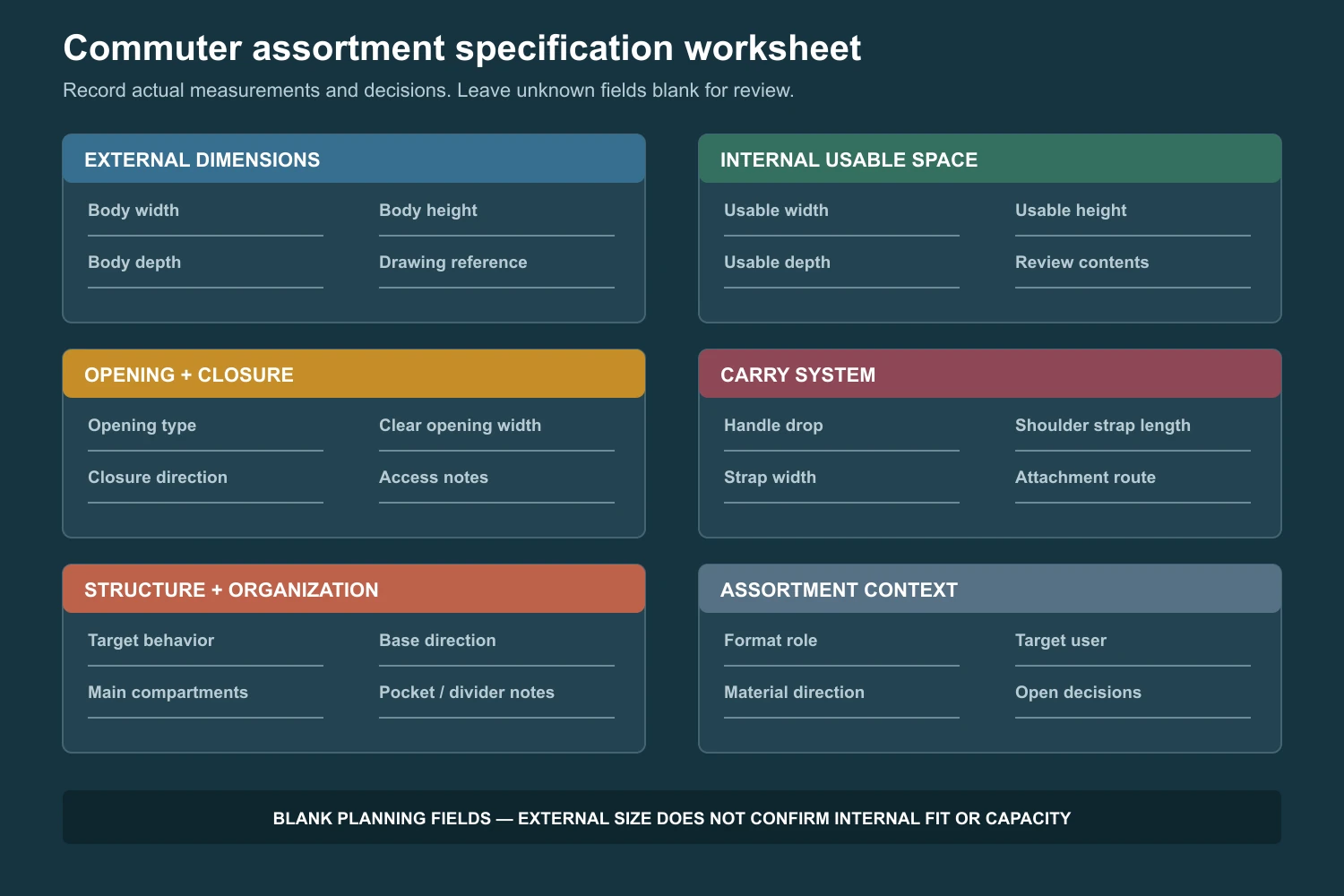
Ask for responses against the same rows. When a supplier proposes an alternative, record what changed and whether it still performs the assigned role. That keeps quotation comparisons useful without turning a substituted style into an unnoticed change to the whole assortment.
Frequently Asked Questions
How many formats should a first work-bag range include?
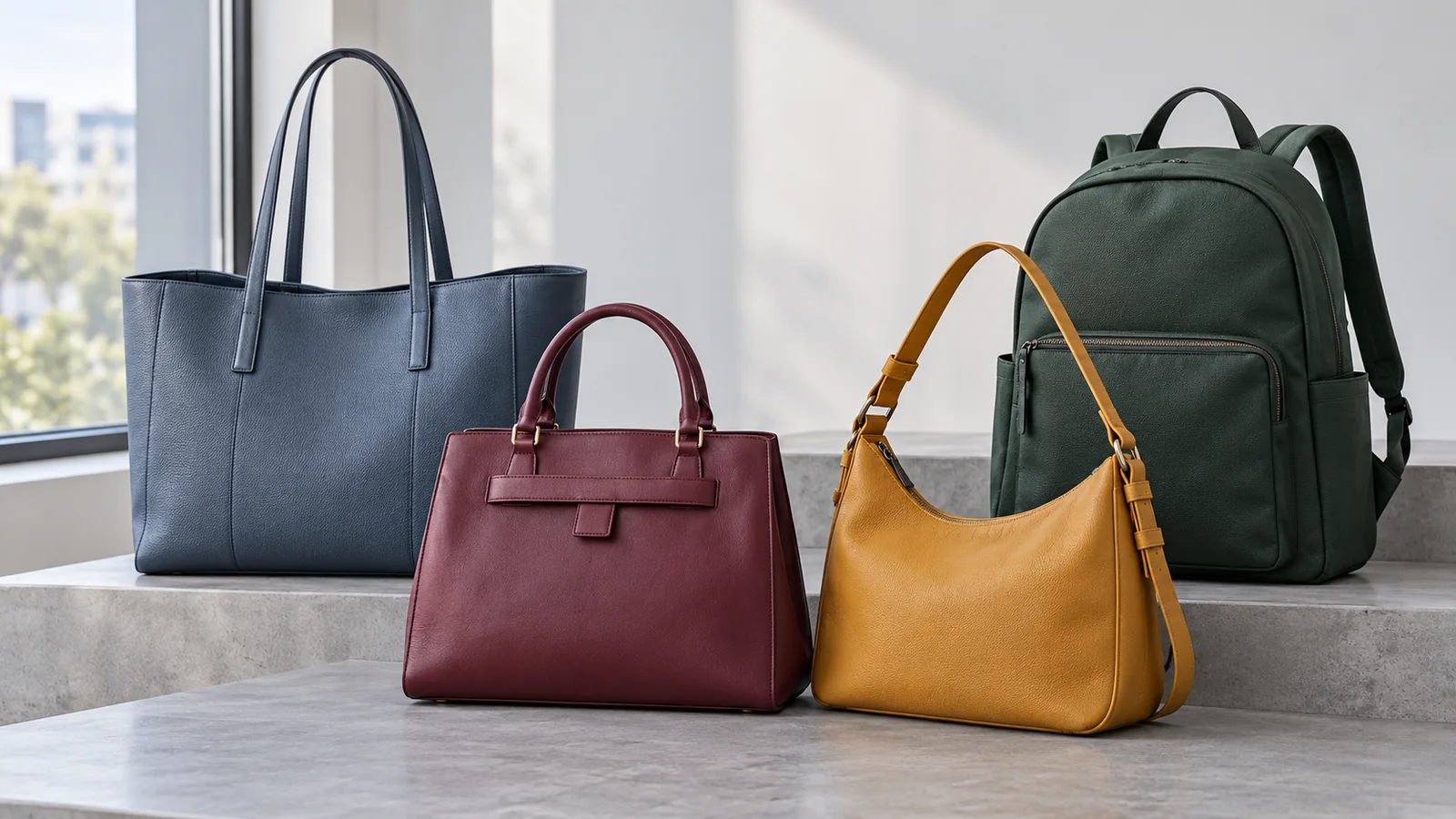
There is no fixed number. Begin with the principal use requirement and add a format only when it offers a distinct choice you can source and explain. Four formats in an illustration are planning examples, not a required purchase list.
Can all larger work bags be described as laptop-compatible?
No. Confirm the device and case dimensions, usable interior, opening and the selected sample. Until that review is complete, describe the known dimensions without promising compatibility or protective performance.
Does custom MOQ apply to the total assortment?
Do not assume quantities across unrelated styles or colors can be combined. Ask how the proposed material and customization affect each candidate. State the quantity breakdown and flexibility; keep any custom-production reference separate from stock-order terms.
What quantity should a buyer request for ready stock?
Provide the intended quantity for the specific style and color, then ask what is currently available and workable. A product listing, a historical assortment plan or a custom MOQ reference does not confirm a stock quantity.
Turn the Range Plan Into a Sourcing Review
A useful work-bag assortment gives each style a reason to exist and each quote a clear set of assumptions. Keep the role descriptions, comparison notes and quantity rows together. Remove unresolved claims before they become product copy, and revisit overlap when a sample or substitution changes the original selection.
Share your target market, preferred formats, material direction and quantity plan for a curated sourcing review.